The growing significance of interdisciplinary research approaches and international collaborations in solving contemporary scientific problems took center stage at a major academic gathering in Tamil Nadu. A two-day Indo-Taiwan academic conference, jointly organized by SASTRA Deemed University in Thanjavur and Taiwan's Lungwha University of Science and Technology, brought together leading academic minds from both nations to chart collaborative pathways forward.
Fostering Cross-Border Academic Partnerships
Speakers at the conference strongly emphasized that addressing today's complex scientific challenges requires breaking down traditional disciplinary boundaries and establishing robust global partnerships. The event served as a platform for academicians from India and Taiwan to engage in substantive discussions about emerging trends across multiple scientific domains, including advanced engineering disciplines and applied mathematics.
Exploring Collaborative Opportunities
Beyond theoretical discussions, participants actively explored practical avenues for strengthening academic ties between the two countries. Key areas of focus included establishing joint research initiatives, developing faculty exchange programs, and creating student collaboration opportunities that would benefit both Indian and Taiwanese academic institutions.

Parallel Workshop on Scientific Computing
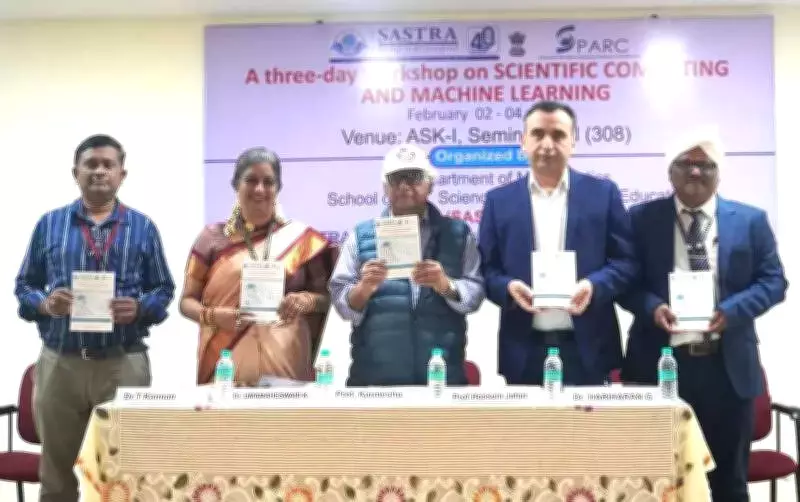
Simultaneously, SASTRA's department of mathematics organized a three-day international workshop titled "Scientific Computing and Machine Learning" from February 2 to 4. This complementary event featured presentations from distinguished professors showcasing cutting-edge computational methodologies.
Innovative Computational Methods
Professor Hossein Jafari delivered an insightful presentation explaining the Hosoya collocation method, an advanced technique for obtaining numerical solutions to variable order differential equations that has significant applications in computational mathematics and engineering.
Bridging Theory and Practice
Professor Karmeshu from UPES, Dehradun addressed the crucial challenge of connecting theoretical foundations with practical implementations in modern deep learning systems, highlighting approaches to make advanced AI methodologies more applicable to real-world problems.
Marine Applications of AI
The workshop also featured presentations on specialized applications of artificial intelligence. Suresh Rajendran from IIT Madras highlighted the transformative role of deep reinforcement learning in autonomous marine navigation systems, while T V S Udaya Bhaskar of ESSO-INCOIS discussed practical applications of machine learning and computer vision technologies in oceanography research.
These parallel events collectively demonstrated how interdisciplinary approaches combining mathematics, computer science, and domain-specific knowledge can drive innovation across diverse scientific fields, from fundamental computational methods to specialized applications in marine science and artificial intelligence.