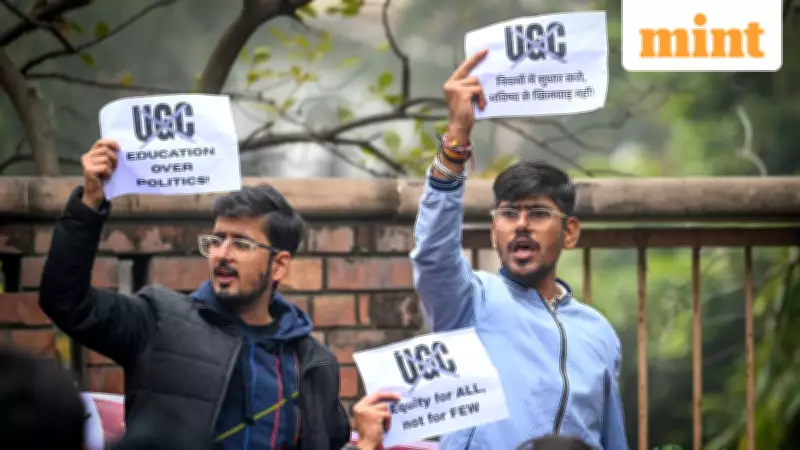
UGC's 2026 Equity Regulations: A Mandatory Framework Against Caste Discrimination
In his seminal work Caste Matters, prominent Dalit scholar Suraj Yengde poignantly captured the enduring anguish of caste oppression. He articulated, “Until my mother can sleep with reassurance without worrying about her son's returning home safely in the caste police regime; until then, caste matters.” This stark reality underscores the critical need for systemic intervention in India's educational landscape.
New Mandatory Regulations Replace 2012 Framework
On January 13, the University Grants Commission (UGC) unveiled the Equity Regulations for 2026, formally replacing the older 2012 framework. These comprehensive rules are designed to proactively prevent discrimination and caste-based bias across higher education institutions. Unlike the previous voluntary guidelines, the 2026 regulations enforce mandatory compliance, introducing significant structural changes and stricter accountability mechanisms.
Key Changes and Enhanced Protections
The 2012 regulations were largely ineffective due to the absence of real penalties for non-compliance, leading to poor or nonexistent implementation in many institutions. The 2026 framework fundamentally alters this by requiring every higher education institution to establish mandatory structures that were previously optional or limited in scope.

The three core mandatory structures include:
- An Equal Opportunity Centre (EOC) dedicated to promoting inclusion, handling formal complaints, and conducting awareness programs.
- An Equity Committee with mandatory representation from Scheduled Castes (SC), Scheduled Tribes (ST), Other Backward Classes (OBC), women, and persons with disabilities (PwD).
- A 24/7 equity helpline, the appointment of equity ambassadors across academic departments and facilities, and mobile equity squads for continuous campus monitoring and reporting.
The scope of protection has been substantially expanded. While the 2012 rules primarily focused on SC/ST students, the 2026 version explicitly includes OBCs in its definition of caste-based discrimination, alongside SC/ST. It broadens coverage to encompass faculty, non-teaching staff, gender minorities, PwD, and in certain contexts, economically weaker sections (EWS), applying comprehensively to all institutional stakeholders.
Consequences of Non-Compliance and Monitoring
Under the 2026 regulations, failure to comply carries serious repercussions. Penalties can include exclusion from UGC funding schemes, revocation of permission to offer degree or online programs, and even removal from official UGC recognition lists. Compliance will be rigorously monitored through a national-level oversight committee and mandatory annual reporting submitted by each institution.
Broadened Definition of Discrimination
Discrimination is now defined more expansively as any unfair, biased, or differential treatment—whether overt or subtle—based on caste, religion, race, gender, place of birth, disability, or similar grounds, provided it harms educational equality or human dignity. This definition moves beyond merely addressing overt acts against SC/ST communities.
The complaint mechanism mandates that grievances be directed to the EOC or the helpline, with options for confidentiality. The Equity Committee is required to convene within 24 hours of receiving a complaint, submit an investigative report within 15 working days, and the institution's head must take action within an additional 7 days, including police referral if necessary.
Rising Complaints and Data Insights
According to UGC data presented to parliamentary committees and cited in Supreme Court proceedings, reported complaints through Equal Opportunity Cells (EOCs) and SC/ST Cells across 704 universities and 1,553 colleges surged by 118.4% over the five-year period from 2019-20 to 2023-24.
The annual complaint figures illustrate a concerning upward trend:

- 2019-20: 173 complaints
- 2020-21: 182 complaints
- 2021-22: 186 complaints
- 2022-23: 241 complaints
- 2023-24: 378 complaints (peak)
This amounts to a cumulative total of 1,160 complaints during this timeframe. Of these, 1,052 were resolved, achieving a disposal rate of approximately 90.68%. However, pending cases grew significantly from 18 in 2019-20 to 108 by 2023-24, highlighting ongoing challenges in timely resolution.
The Rohit Vemula Case and Legislative Demands
The tragic case of Rohit Vemula, a Dalit research scholar who died by suicide in a hostel room at the University of Hyderabad on January 17, 2016, remains one of the most controversial incidents. His death ignited nationwide protests and renewed demands for a central anti-discrimination law for higher education students, often referred to as the “Rohith Act.” Such national legislation has yet to be enacted.
Earlier this month, Telangana Deputy Chief Minister Mallu Bhatti Vikramarka announced that the Rohit Vemula Act would be introduced in the state at the earliest opportunity, reflecting persistent advocacy for stronger legal safeguards.
Political Criticism and Reactions
The UGC's new regulations have ignited significant political debate. Supporters argue they are essential for protecting marginalized groups, while critics voice concerns over potential misuse or the exclusion of non-reserved categories.
Bharatiya Janata Party (BJP) leader Kalraj Mishra criticized the guidelines, labeling them “unconstitutional” and alleging they promote “separatism” rather than ensuring equal opportunity for all students. He stated, “We have demanded that the unconstitutional rules, which are based on caste discrimination, and which include OBCs, should be amended. I believe that all sections of society need to be included in this.”
The Communist Party of India (Marxist) or CPI(M) urged the UGC to extend the new regulations to premier institutions like IITs, IIMs, and AIIMS. The party also called for democratic formation of equity committees, rather than leaving appointments to institutional heads' discretion. The CPI(M) accused the BJP-led government of increasing “communalised education” by introducing regressive elements into curricula, specifically citing the inclusion of texts like the Manusmriti, which it claims legitimizes caste discrimination. The party further alleged that RSS-affiliated organizations are exploiting the new regulations to foment caste divisions within educational institutions.
As these regulations move toward implementation, they represent a pivotal, yet contentious, step in addressing deep-seated caste-based inequities in India's higher education system, balancing ambitious protections with complex political and social realities.