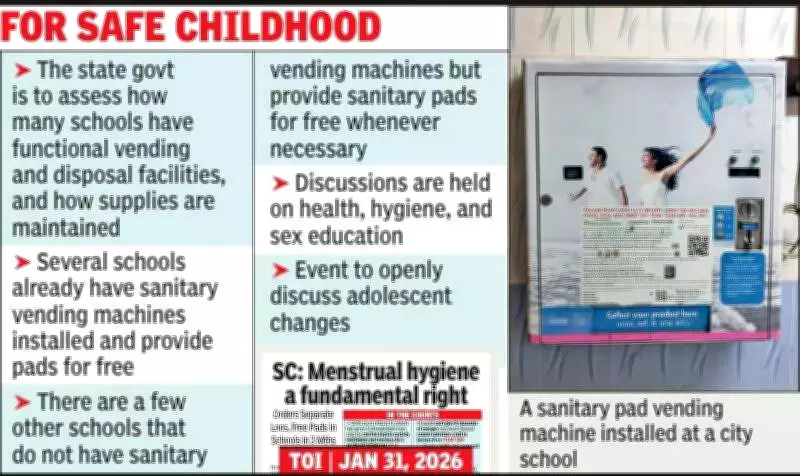
Bengal Schools Review Menstrual Hygiene Facilities Following Supreme Court Directive
In Kolkata, a nearly two-decade-long initiative to create safer and more comfortable school environments for girls during menstruation is receiving renewed attention across West Bengal. This comes as the state education department prepares to comprehensively review menstrual hygiene facilities in government-run schools, following a significant Supreme Court order issued on Friday.
Integrating Hygiene into School Health Practices
State education officials have confirmed that menstrual hygiene is now being treated as an integral component of overall cleanliness and health protocols within government schools. The focus encompasses multiple critical areas:
- Ensuring reliable access to sanitary products
- Implementing safe and hygienic disposal systems
- Conducting awareness programmes for both students and parents
"Several schools already have vending machines and dispensers installed in girls' toilets. Since this is fundamentally a health and hygiene issue, we organize numerous awareness programmes across schools to educate students. In many instances, parents are also actively included in these educational initiatives," explained an official from the school education department.

State Commits to Assessment and Improvement
A senior department official emphasized the state's commitment to evaluating existing arrangements and addressing any identified shortcomings. "We have already implemented many measures in this regard. However, we will conduct a thorough review shortly in response to the Supreme Court order. Should we discover any gaps, we are prepared to take all necessary actions to rectify them," the official stated.
A Tragedy That Sparked Lasting Change
The origins of this sustained campaign in parts of West Bengal can be traced back to a heartbreaking tragedy in South 24 Parganas district. In 2007, the death of a 13-year-old student, allegedly linked to unhygienic menstrual practices, became a profound turning point for Krishnachandrapur High School and the surrounding communities.
Chandan Maiti, the school's headmaster, recalled the incident with deep solemnity. "We took this tragedy very seriously. It compelled us to act. We began installing sanitary pad vending machines with support from the Rotary Club of Salt Lake Central and the Jute Corporation of India, supplemented by our own school funds," Maiti recounted.
He highlighted that the school's mission extended beyond mere infrastructure. "We also sought to dismantle the stigma associated with seeking sanitary products. We took a solemn oath that no girl child in our care would suffer such a fate again. Our initiative eventually expanded beyond the school campus, reaching into remote villages to sensitize families," he added. Today, the school boasts multiple vending machines across its campus and three hostels.
Widespread Implementation in Kolkata Schools
Other schools in Kolkata report similar proactive systems. Sarbani Sen, headmistress of Santoshpur Rishi Aurobindo Balika Vidyapith, detailed their approach: "We have installed vending machines on every floor of the school. Furthermore, we have dedicated disposal arrangements, including a special bin in every toilet. One teacher is specifically assigned to oversee all these facilities and ensure they function properly."
Most schools affiliated with the CISCE and CBSE boards stated they have already implemented various menstrual hygiene measures. Rodney Borneo, principal of St Augustine's Day School, welcomed the Supreme Court's direction. He revealed that his school has been using an automatic dispenser system for the past two years. Students access sanitary pads privately through a discreet token-based mechanism, and safe disposal is facilitated by an incinerator located in the girls' infirmary.
Reinforcing a Long-Standing Need
Rupkatha Sarkar, principal of La Martiniere School for Girls, noted that the court order reinforces a long-standing need. "Our school provides sanitary napkins free of cost directly through the infirmary, ensuring access even without vending machines," she stated.

Similarly, Arun Kumar Dasgupta, principal of Bharatiya Vidya Bhavan, confirmed that vending machines and proper disposal systems were installed two years ago. "Beyond infrastructure, we have also significantly expanded our health education curriculum to include comprehensive menstrual health awareness," Dasgupta added.
This statewide review, prompted by judicial intervention, represents a critical step in consolidating and expanding upon two decades of grassroots and institutional efforts to safeguard the health, dignity, and education of young girls across West Bengal.