Calcutta High Court Upholds IIM-C's Decision on MBA Student with Schizophrenia
The Calcutta High Court has firmly refused to intervene in the academic progression of an MBA student at the Indian Institute of Management Calcutta (IIM-C) who suffers from schizophrenia. On February 18, the court declined to order the student's promotion to the second year, citing consistently poor grades and inadequate attendance as the primary grounds for the institution's decision.
Court's Observations on Institutional Authority and Parental Role
Justice Shampa Dutt (Paul), presiding over the case, delivered a significant observation regarding the dynamics of academic governance and parental involvement. The court stated that an educational institution is the most qualified authority to determine what constitutes the genuine welfare of its students. In this context, parents should ideally assume a supporting role rather than allowing the situation to escalate into a matter of personal ego.
"Such an approach sets a wrong example for the child in the long run," Justice Dutt (Paul) remarked, highlighting the potential negative consequences of challenging institutional academic judgments on emotional or sympathetic grounds alone.

Details of the Academic Performance and Legal Petition
The student had approached the Calcutta High Court after IIM-C directed him to repeat his first year of the MBA program. Consequently, he was not permitted to participate in campus placement activities with his original batchmates. The institution's decision was rooted in his academic record, which failed to meet the required standards.
Justice Dutt (Paul) noted the arguments presented by IIM-C, which revealed that despite being granted make-up examinations—accommodations made in consideration of medical certificates submitted by the student—his performance remained subpar. His unadjusted cumulative grade point average (CGPA) stood at 4.4, and even after adjustments, it was only 3.4. The minimum required CGPA for promotion was 4.5.
Chronology of Communications and Academic Actions
The timeline of events presented in court painted a clear picture of the academic challenges faced:
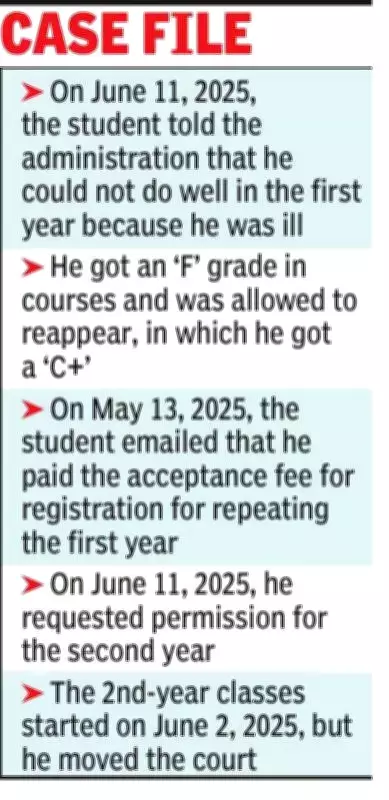
- June 11, 2024: The student emailed the administration, attributing his poor first-year performance to his mental health condition, schizophrenia.
- The college administration responded, noting his absence from exams during the 2024-25 academic year. He had received an 'F' grade in certain courses, was allowed to reappear for them, and subsequently achieved a 'C+' grade.
- May 13, 2025: The student confirmed via email that he had paid the acceptance fee to register for the 62nd batch, effectively agreeing to repeat the first year.
- June 11, 2025: In a contradictory move, he requested conditional permission to join the second year instead. Notably, second-year classes had already commenced on June 2, 2025.
Instead of attending classes for the repeated first year, the student chose to pursue legal action. The judge observed that he had not attended classes for either the first year he was supposed to repeat or the second year he sought to join.
Judicial Reasoning on Academic Integrity and Sympathy
Justice Dutt (Paul) expressed concern over the student's apparent haste to obtain a degree without fulfilling the fundamental academic requirements of class attendance and performance. "The student seems to be in a hurry to get a degree, without properly attending any classes at all, in spite of the doctor noting that his condition is better (controlled)," the judge noted.
Furthermore, the court scrutinized the medical documentation submitted, observing that some certificates pertained to minor ailments such as stomach problems and viral fever, which were not directly linked to his primary diagnosis of schizophrenia.

The judgment emphasized a critical principle of academic governance: awarding a degree to a student despite poor grades or attendance sends a detrimental message to the entire student community. "...and in such cases, sympathy or compassion should have no role to play and, in the event of a doubt, the benefit should go to the institution rather than the student, as such indulgence will not create difficulties for the institution but also the students," Justice Dutt (Paul) concluded, reinforcing the necessity of upholding academic standards for the integrity of the institution and the value of its degrees.