Hyderabad International School Sparks Controversy with Sudden Admission Cancellations
Just days into the new academic session, an international school in Hyderabad has generated significant controversy by abruptly terminating the admission of at least four students. The school management attributes this drastic action to what they describe as "unruly behaviour" from parents, while affected families counter that it represents retaliation for their complaints about discriminatory practices against students with pending fees.
Conflicting Narratives Emerge in School Dispute
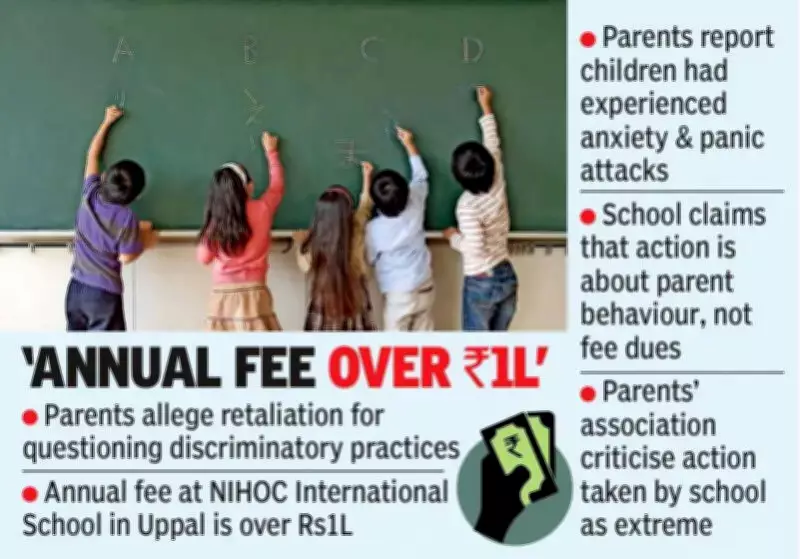
The management of NIHOC The International School in Uppal issued letters dated April 8 informing parents of the admission cancellations. These communications cited "violation of the school's Parent Behaviour Policy and established rules" as the justification for the decision. However, parents involved in the situation present a dramatically different account.
"When we confronted the management over this discriminatory practice, they handed us admission termination letters citing violation of a school policy that many of us are not even aware of," explained one aggrieved parent. "My son had a panic attack after he was segregated from his class."

Fee-Related Discrimination Allegations Surface
Parents speaking to media outlets claimed that prior to the admission cancellations, the school had implemented what they describe as discriminatory practices against students whose families had not fully cleared their fees. According to these accounts, multiple students were reportedly forced to sit in a separate room throughout school hours because part of their fees remained unpaid.
"This left the children embarrassed with many students complaining of anxiety and breathing issues afterwards," parents stated. One parent detailed paying approximately 1 lakh rupees toward their child's annual fee, which exceeds that amount, with only 37,000 rupees pending while awaiting a response to a sports quota concession request.
School Management Presents Different Perspective
School representatives firmly denied any connection between the admission cancellations and outstanding fee payments. Manideepa K, academic counsellor of the institution, emphasized that "the cancellation of admission had nothing to do with fee dues."
"It was more about how the parents behaved," she explained. "They were rude and intimidating towards our staff and teachers. Their behaviour was unacceptable, and in violation of the school's code of conduct."
The school's official letter to parents stated: "Maintaining a respectful and positive environment is of utmost importance to us, and such instances are taken very seriously. In view of this, the school has decided to cancel your child's admission with immediate effect."
Discrepancy in Numbers and Parent Association Concerns
While school management maintains that only four students received admission termination letters, some parents have claimed the number affected could be as high as ten. This discrepancy adds another layer of complexity to the unfolding situation.
Education advocates and parent association representatives have expressed serious concerns about the school's actions. K Venkat Sainath from the Hyderabad School Parents Association commented: "First of all, making a child sit separately is against rules. It is unfortunate that we do not have any grievance mechanism to raise such issues."
He further questioned the proportionality of the school's response: "They can ask the parent to apologise, write a letter, or ask them not to set foot inside the campus. But cancelling a child's admission doesn't make sense."
Broader Implications for School-Parent Relationships
This incident highlights growing tensions in educational institutions regarding appropriate boundaries between school authority and parent rights. With annual fees at the international school exceeding 1 lakh rupees, expectations for transparent communication and fair treatment run high among paying families.
The controversy raises important questions about how schools should address behavioural concerns with parents while ensuring children's education remains uninterrupted. It also underscores the need for clear, mutually understood policies and effective grievance redressal mechanisms within educational institutions.

As the situation develops, it serves as a case study in the complex dynamics between private educational institutions and the families they serve, particularly regarding fee structures, behavioural expectations, and conflict resolution protocols in Hyderabad's competitive educational landscape.