Rajasthan High Court Intervenes in CBSE Affiliation Dispute with Neerja Modi School
In a significant development for educational institutions, the Rajasthan High Court on Wednesday provided interim relief to Jaipur's Neerja Modi School by staying an order from the Central Board of Secondary Education (CBSE) that had restricted its senior secondary affiliation. The court's intervention comes amid ongoing legal proceedings concerning the school's compliance with regulatory standards.
Court Imposes Specific Conditions for Stay Order
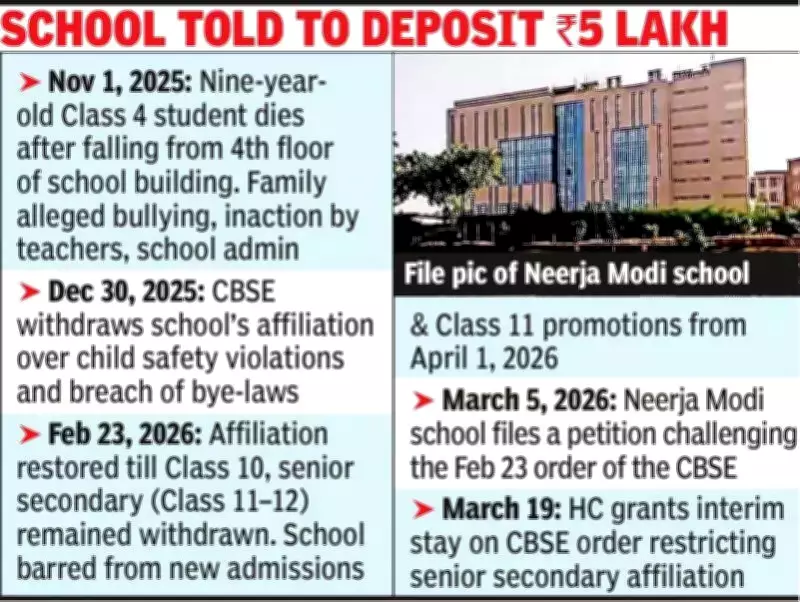
The bench, however, did not grant unconditional relief. Justice Ganesh Ram Meena, presiding over the single bench, laid down several conditions that the school must fulfill. The institution has been directed to deposit ₹5 lakh with CBSE within ten days, with this amount to be kept in a fixed deposit account pending the final outcome of the case. Additionally, the court mandated that the school rectify all identified deficiencies within one month.
The court has further instructed CBSE to conduct a fresh inspection of the school premises after 45 days, granting the board liberty to approach the court again if deficiencies remain unaddressed. In a move to ensure student welfare, the court has asked CBSE to prepare and share a list of alternative schools that meet prescribed norms, should student relocation become necessary.

Background of the CBSE Order and School's Challenge
The legal dispute stems from CBSE's February 23 decision, which was later modified to restore the school's affiliation up to secondary level while withdrawing senior secondary affiliation for Classes 11 and 12 for the 2026–27 and 2027–28 academic sessions. The board also prohibited fresh admissions in Class 11 during this period, though existing students were permitted to continue and appear for board examinations.
Representing the school, senior advocate AK Sharma, assisted by Rachit Sharma, argued that the institution has been operational since 2001 with approximately 5,500 students and held valid affiliation until March 31, 2029. The counsel referenced an unfortunate incident on November 1, 2025, when a nine-year-old student fell to death from the fourth floor of the school premises, noting that the concerned teacher's services had been terminated.
Sharma further contended that most deficiencies highlighted in CBSE's November 3, 2025 communication had already been addressed, with remaining issues to be resolved within a month. He emphasized that the CBSE order created unnecessary uncertainty among students who were not at fault.
CBSE and Parental Opposition to School's Plea
Opposing the school's petition, CBSE counsel MS Raghav maintained that there were violations of statutory provisions under affiliation bye-laws and that proper procedure, including issuance of a show-cause notice, had been followed before the order was passed. Counsel for parents, SS Hora, argued vigorously that even minor regulatory violations warrant penalties, including potential de-affiliation, and such matters should not be treated with leniency given their impact on educational standards and student safety.
The court's decision to grant interim relief while imposing strict conditions represents a balanced approach, acknowledging both the school's operational history and the regulatory authority's concerns. The case continues to highlight the ongoing tension between institutional autonomy and regulatory compliance in India's educational landscape.