UPSC Prelims 2026: Comprehensive History and Culture Quiz for Aspirants
As UPSC Prelims 2026 approaches, rigorous revision of static syllabus topics becomes crucial for aspirants. This daily subject-wise quiz initiative focuses on History and Culture, covering essential themes from Mahatma Gandhi's legacy to the colonial history of North-Eastern India and architectural marvels like the Undavalli Caves. Designed to test and enhance your knowledge, these multiple-choice questions (MCQs) help identify areas needing further study.
Question 1: Mahatma Gandhi's Ideological Stances and Historical Impact
Consider the following statements regarding Mahatma Gandhi:
- His fast unto death resulted in the Poona Pact, which abolished separate electorates in favor of reserved constituencies where all voters could elect candidates from reserved categories—a move that drew severe criticism from B. R. Ambedkar.
- While defending idol worship and the Hindu concept of reincarnation, Gandhi did not identify himself as an orthodox Hindu.
Which of the statements is/are correct?

- (a) 1 only
- (b) 2 only
- (c) Both 1 and 2
- (d) Neither 1 nor 2
Explanation: Gandhi's stance on religious practices was nuanced. In 1933 correspondence, he defended idol worship, stating it provided solace to those who needed tangible representations of divinity. He also upheld reincarnation as a core Hindu belief, asserting that disbelief in it would disqualify one from being considered Hindu. However, Gandhi described himself as an orthodox Hindu in a reformative sense, emphasizing continuous spiritual striving rather than rigid social customs.
Politically, his 1932 fast unto death against the Communal Award led to the Poona Pact, replacing separate electorates with reserved constituencies. This decision, while integrating Dalits into the broader electoral framework, was criticized by Ambedkar for potentially diluting Dalit political autonomy. Thus, only statement 1 is accurate, making (a) the correct answer.
Question 2: Colonial History of North-Eastern India
Evaluate these statements about North-Eastern India's pre-Independence status:
- Before Independence, Arunachal Pradesh, Meghalaya, Tripura, and Mizoram were integral parts of colonial Assam.
- Manipur and Nagaland functioned as princely states under British political officers reporting to the Assam governor.
- Sikkim maintained judicial independence under British paramountcy, became independent in 1947, and was annexed by India in 1975.
Which statements are not true?
- (a) 1 only
- (b) 1 and 2 only
- (c) 2 and 3 only
- (d) 3 only
Explanation: Historically, five modern states—Arunachal Pradesh, Assam, Meghalaya, Nagaland, and Mizoram—were part of colonial Assam. Manipur and Tripura were princely states with British political oversight, not Nagaland. Sikkim did enjoy judicial autonomy under the British, gained independence in 1947, and was integrated into India in 1975. Therefore, statement 1 is false as it incorrectly includes Tripura, and statement 2 is false regarding Nagaland. Only statement 3 is accurate, making (d) the correct answer.
Question 3: Authors and Their Literary Works
Match the following books with their authors:
- Ghubar-e-Khatir : Muhammad Iqbal
- The Golden Threshold : Sarojini Naidu
- India Divided : Vallabhbhai Patel
Which pairs are correct?
- (a) 1 and 2 only
- (b) 2 only
- (c) 3 only
- (d) 1, 2 and 3
Explanation: The correct associations are: Ghubar-e-Khatir was penned by Maulana Azad, not Muhammad Iqbal. The Golden Threshold is indeed by Sarojini Naidu, a celebrated poet and political activist. India Divided was authored by Rajendra Prasad, India's first President, not Vallabhbhai Patel. Thus, only pair 2 is correct, making (b) the answer.
Question 4: The Glorious Vijayanagara Empire
Assess these statements about the Vijayanagara Empire:

- The Prasanna Virupaksha and Hazara Rama temples exemplify Vijayanagara's distinctive architectural style and detailed craftsmanship.
- The kingdom fostered literature in Tamil, Telugu, Kannada, and Sanskrit, introducing innovative writing styles.
- Traveller Alberuni documented bustling ports like Mangalore and Honavar, which attracted global traders and served as shipbuilding hubs.
Which statements are correct?
- (a) 1 and 2 only
- (b) 1 and 3 only
- (c) 2 and 3 only
- (d) 1, 2 and 3
Explanation: The Vijayanagara Empire (1336-1646) was a beacon of cultural and economic prosperity. Architecturally, temples like Prasanna Virupaksha and Hazara Rama showcase intricate artistry, blending Chalukya, Hoysala, Pandya, and Chola influences. Literarily, it was a polyglot hub, producing works in multiple languages with stylistic innovations. However, it was the traveller Abd al-Razzaq Samarqandi, not Alberuni, who chronicled the empire's thriving ports and their role in international trade and shipbuilding. Thus, statements 1 and 2 are correct, making (a) the answer.
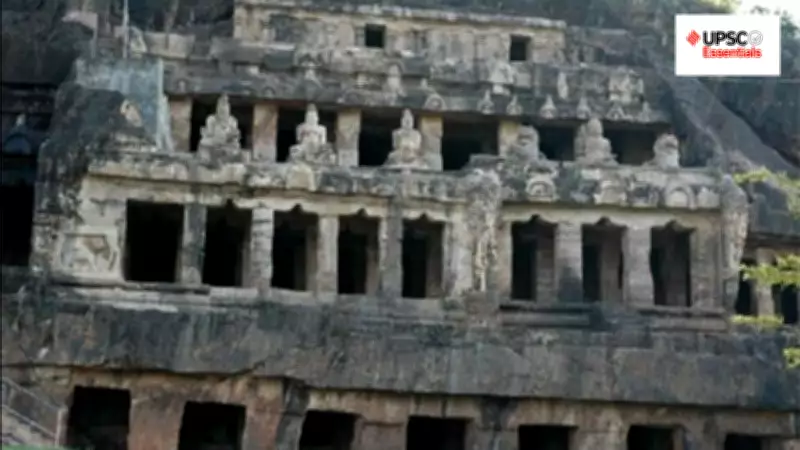
Question 5: Historical Significance of Undavalli Caves
The Undavalli Caves are historically linked to which dynasty?
- (a) Solanki dynasty
- (b) Vishnukundina dynasty
- (c) Karkota Dynasty
- (d) Utpala Dynasty
Explanation: Dating to the 7th century BC, the Undavalli Caves in Andhra Pradesh are a masterpiece of rock-cut architecture. These sandstone caves are associated with the Vishnukundina dynasty, which ruled from 420 AD to 620 AD. The largest cave features a monumental reclining statue of Lord Vishnu, carved from a single granite block, alongside Jain tirthankara sculptures and vibrant frescoes. Therefore, (b) is the correct answer.
Enhancing UPSC Preparation Through Regular Quizzes
Consistent practice with such quizzes aids in reinforcing key historical facts and analytical skills. Aspirants are encouraged to review previous quizzes on International Relations, Polity and Governance, Science and Technology, Economy, and Environment and Geography for a holistic preparation strategy. Engaging with these resources helps build a robust foundation for the UPSC Civil Services Examination, turning challenges into opportunities for growth.