Andhra University's Centenary Sparks Renewed Push for Central University Status
As Andhra University prepares to celebrate its centenary in April, a growing chorus of alumni and former faculty members is advocating for the institution to be granted Central University status. This move is seen as crucial for ensuring the university's long-term sustainability, which is currently threatened by severe faculty shortages, inadequate funding, and deteriorating infrastructure. The university marks 100 years of existence on April 26, making this a pivotal moment for its future.
Urgent Need for Central Status to Secure Future
Former professors and vice-chancellers argue that granting Central University status would not only secure Andhra University's future but also strengthen its academic and administrative autonomy. Such a transition would provide greater access to central funding, national research missions, and collaborative academic programs. It would also facilitate regular faculty recruitment and infrastructure development, enabling the university to compete more effectively with leading institutions across India.
Currently, the university operates with only about 20 percent of the required regular faculty strength. The block grant from the state government is barely sufficient to cover salaries and pensions, while internal revenue generation has steadily declined. Over the past two decades, the establishment of state universities in nearly every district of Andhra Pradesh and the entry of private institutions have intensified competition. The absence of faculty recruitment for at least 15 years has severely impacted teaching and research output, diminishing the university's academic standing and brand value.

Infrastructure and Admission Challenges
Simultaneously, the historic campus, which served the educational needs of coastal Andhra Pradesh even before Independence, faces aging infrastructure. Academic buildings, laboratories, and basic amenities require urgent upgrades. Apart from engineering and a few select programs, demand for admissions has declined significantly, further exacerbating the university's challenges.
Interestingly, a similar proposal to grant Central University status was debated around 11-12 years ago during the UPA regime. While it received a mixed response at the time, many stakeholders now view it as a necessity due to the gradually deteriorating conditions and growing challenges facing Andhra University.
Voices from Alumni and Former Faculty
Dr. MS Reddy, a botany alumnus (1975-77) and current professor in the United States, emphasized that granting Central University status during the centenary year would secure AU's future and strengthen its autonomy. "Such a transition would significantly enhance its global academic reputation and rankings, enable greater access to central funding, national research missions, and international collaborations, and help attract world-class faculty and students. Above all, it would preserve and elevate a century-old national academic heritage," said Prof. Reddy, who has written to the state government on the issue.
Former registrar Prof. V Umamaheswara Rao highlighted that Andhra University is grappling with acute faculty shortage, aging infrastructure, and a gradual decline in rankings, despite high accreditation grades. "While student placements remain strong in select disciplines, overall academic quality has suffered. Restoring the university will require merit-based recruitment, greater institutional autonomy, closer industry-academia collaboration, financial self-reliance, and active alumni engagement. Strong and accountable leadership is essential to revive Andhra University and position Andhra Pradesh as a knowledge-driven economy," he opined.
Prof. EUB Reddy, former head of the department of environmental sciences, stressed the importance of long-term sustainability, noting that a large proportion of students come from below-poverty-line and middle-class families. "At this juncture, granting Central University status could revitalise Andhra University across multiple fronts, including faculty strength, funding, research opportunities, infrastructure development, and student amenities," he said.
Key Recommendations for Revival
To address these challenges, stakeholders have proposed several measures:

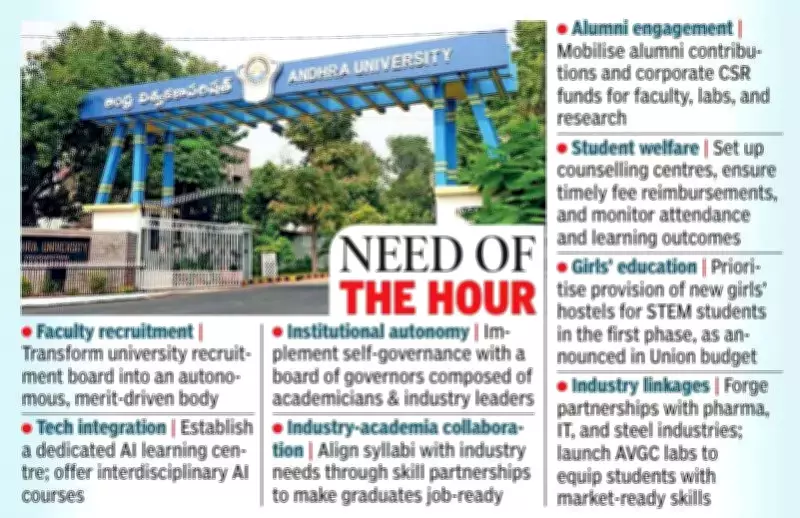
- Faculty Recruitment: Transform the university recruitment board into an autonomous, merit-driven body.
- Technology Integration: Establish a dedicated AI learning center and offer interdisciplinary AI courses across sectors like software, agriculture, fisheries, and manufacturing.
- Institutional Autonomy: Implement self-governance with a board of governors composed mainly of academicians and industry leaders, and ban political campaigns on campus.
- Industry-Academia Collaboration: Align syllabi with industry needs through skill partnerships to make graduates job-ready.
- Alumni Engagement: Mobilize alumni contributions and corporate CSR funds for faculty, labs, and research.
- Student Welfare: Set up counseling centers, ensure timely fee reimbursements, and monitor attendance and learning outcomes.
- Girls' Education: Prioritize new girls' hostels for STEM students, as announced in the Union budget, and upgrade digital libraries with high-speed internet and international journals.
- Industry Linkages: Forge partnerships with pharma, IT, and steel industries, and launch AVGC labs to equip students with market-ready skills.
As Andhra University stands at a crossroads, the push for Central University status represents a critical step toward revitalizing this century-old institution and ensuring it continues to serve as a beacon of higher education in the region.