

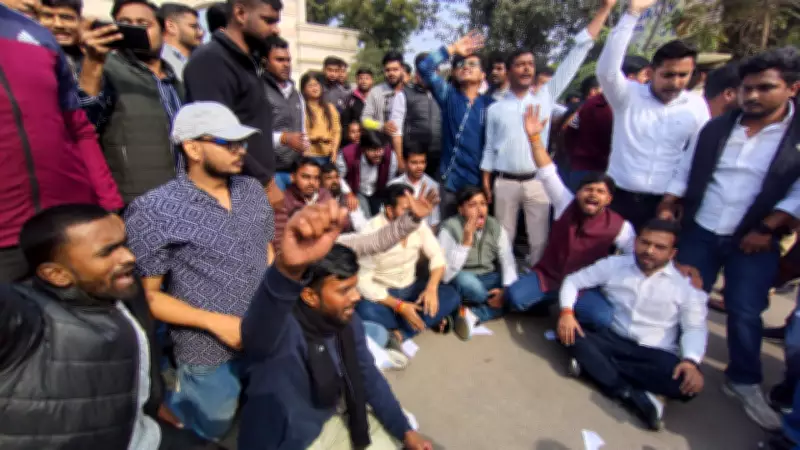
Nationwide Student Uprising Against UGC's New Equity Regulations Intensifies
For the second consecutive day, widespread protests demanding immediate withdrawal of the University Grants Commission's newly introduced Regulations 2026 have swept across Uttar Pradesh and multiple other Indian states on Wednesday. The agitation has gained significant momentum with student organizations, social groups, and even functionaries from ruling political parties joining the movement, culminating in calls for a nationwide Bharat bandh scheduled for February 1.
Lucknow: Epicenter of Student Resistance
In the state capital Lucknow, students representing Chhatra Panchayat gathered in substantial numbers at the iconic Gandhi statue in Hazratganj, creating a powerful visual of dissent. The air resonated with passionate slogans including "UGC Roll Back," "Bantenge Toh Katenge," and "Ek Hain Toh Safe Hain" as protesters voiced their collective opposition. The demonstrators presented a compelling argument that the regulations, despite being framed under the banner of equity, contain discriminatory provisions that threaten to fragment university campuses along divisive lines.
Chhatra Panchayat president Shivam Pandey delivered a scathing critique, labeling the regulations as a "black law" that would fundamentally poison the academic environment. "Students share meals, study together, and often remain unaware of each other's surnames or backgrounds. This legislation appears politically motivated with the explicit purpose of dividing the student community," Pandey asserted during the protest. The students contend that the regulations disproportionately impact general category students while failing to address economic hardships within this demographic.

Protests Spread Across Uttar Pradesh
The movement rapidly expanded throughout Uttar Pradesh with significant demonstrations reported from multiple educational hubs:
- Prayagraj: Students affiliated with various organizations assembled at Chhatra Sangh Bhawan on the historic Allahabad University campus, alleging that the new UGC Bill undermines the rights of general category students while lacking adequate safeguards against potentially false complaints.
- Varanasi: Protesters from Banaras Hindu University and Mahatma Gandhi Kashi Vidyapeeth issued stern warnings about intensifying their agitation if the regulations remain unwithdrawn. Their attempt to enter district headquarters was prevented by police, leading to a determined dharna at the site.
- Kanpur: Students of Chandra Shekhar Azad University of Agriculture and Technology staged a symbolic protest wearing black bands and carrying black flags, conducting a foot march from Karpuri Hostel to Company Bagh crossing.
A critical point of contention emerged regarding the composition of proposed grievance redressal and equity committees. Students questioned why these committees mandate representation from OBC, SC-ST communities, women, and persons with disabilities while conspicuously excluding members from upper caste communities. "If the legislation genuinely advocates equality, representation should be mandatory for all sections to prevent future allegations of discrimination," emphasized a participating student.
Political and Social Dimensions Emerge
The protest movement has transcended purely student activism, gaining political and social dimensions across Uttar Pradesh:

- In Deoria, a sit-in demonstration was organized on district court premises under the leadership of Bar Association president Pritam Mishra.
- Rae Bareli witnessed BJP Kisan Morcha's Salon mandal president Shyam Sundar Tripathi submitting his resignation in protest, describing the regulations as "harmful" and "divisive" in his resignation letter addressed to the Prime Minister and party leadership.
- A dramatic video from Kaushambi showing Savarna Army district head Abhishek Pandey writing a letter to the Prime Minister using his own blood went viral on social media, with Pandey similarly condemning the regulations as a black law.
Nationwide Opposition and Legal Challenges
The UGC regulations, officially titled Promotion of Equity in Higher Education Institutions Regulations and notified on January 13 to replace the 2012 guidelines, have triggered opposition beyond Uttar Pradesh. While the government maintains that the rules aim to curb discrimination and promote inclusion, critics have identified specific problematic provisions:
- Clause 3(c) has drawn particular criticism for allegedly providing protection exclusively to SC, ST, and OBC students while leaving general category students without equivalent safeguards.
- The absence of penalties for false complaints has raised concerns about potential misuse of provisions, creating an atmosphere of fear and mistrust on academic campuses.
Bharat Bandh Call Gains Momentum
As protests escalate, multiple organizations have united in calling for a Bharat bandh on February 1:
In Madhya Pradesh, Karni Sena members protested at Devi Ahilya Bai University in Indore, where they recited the Hanuman Chalisa before submitting a memorandum to the vice-chancellor. Karni Sena leaders announced that the bandh would be followed by a campaign to secure written assurances from Members of Parliament opposing the regulations.
Rajasthan's Jodhpur witnessed upper caste groups announcing a city-wide shutdown on February 1, claiming the regulations would create societal divisions. Senior advocate Hastimal Saraswat expressed legal concerns, warning that provisions for swift inquiries could potentially harm innocent individuals.
Government Response and Clarifications
The Union Education Ministry has responded to the growing controversy by announcing plans to issue clarifications addressing what it describes as "misconceptions" surrounding the regulations. Officials have reiterated the government's commitment to protecting the interests of students from all categories. Meanwhile, state administrations across India are implementing precautionary measures in anticipation of the February 1 bandh call, attempting to balance protest rights with public order maintenance.
The nationwide protest movement represents a significant challenge to higher education policy implementation, highlighting deep-seated concerns about equity, representation, and campus harmony in India's educational institutions.





