Patna Streets Witness Angry Protests Over UGC's New Equity Regulations
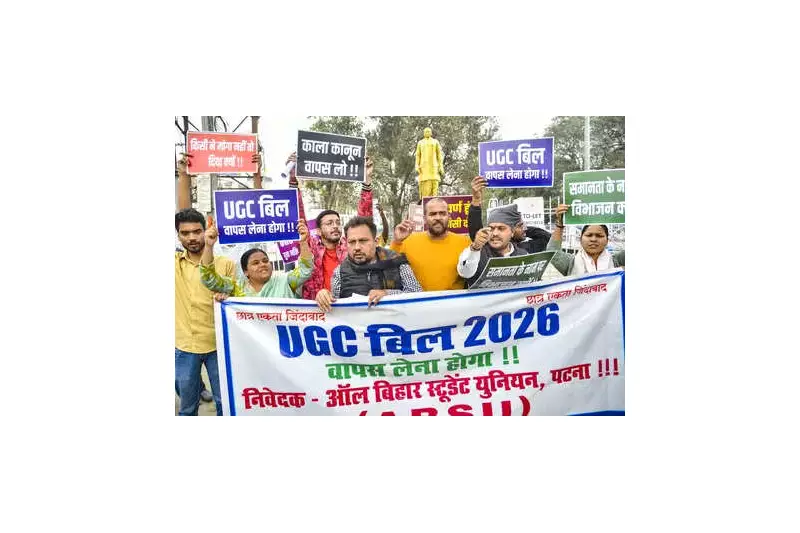
Anger over the University Grants Commission's (UGC) newly notified regulations, officially titled the Promotion of Equity in Higher Education Institutions Regulations, 2026, spilled onto the streets of Patna on Wednesday. Approximately 300 youths, organized under the banners of the All Bihar Student Union and Swarn Samaj Ekta Manch, staged a vigorous protest, accusing the Central government of promoting caste-based divisions in educational institutions.
Protesters Demand Safeguards for General Category Students
The demonstrators, holding placards and shouting slogans against Prime Minister Narendra Modi, alleged that the NDA government is dividing students along caste lines. Their primary demands included equal opportunities for General category students within grievance redressal mechanisms. They called for suitable amendments to the regulations to prevent potential misuse and to uphold the principles of natural justice.
The protesters vehemently argued that the government is discriminating against upper-caste students under the guise of promoting educational equality. They expressed frustration that no deterrent measures have been established to protect General category students from false complaints. Many claimed that discrimination against these students on university campuses based on caste is a persistent issue that remains unaddressed.

Political Polarization and Literary Invocations
The protest also saw participants invoking literature and symbols associated with the revered revolutionary poet Ramdhari Singh 'Dinkar', adding a cultural dimension to their dissent. Meanwhile, the new UGC rules have sharply polarized political parties across Bihar.
The Rashtriya Janata Dal (RJD) and Janshakti Janata Dal leader Tej Pratap Yadav have openly supported the regulations, questioning the silence of the Bharatiya Janata Party (BJP) and its allies. In contrast, petitions challenging the new rules have already been filed in the Supreme Court, indicating the legal battles ahead.
Mixed Reactions from Political Leaders
Senior BJP leader and Deputy Chief Minister Vijay Sinha attempted to calm tensions, stating that the government would examine the matter with full sympathy and seriousness. "There is no need for anyone to be upset or angry," he assured, emphasizing a diplomatic approach.
RJD spokesperson Shakti Yadav defended the UGC regulations as a strong safeguard for reserved categories. He highlighted that complaints of caste-based discrimination in higher education institutions had been raised previously, leading to a committee investigation whose report formed the basis for these new regulations.
BJP MP and Bar Council of India chairman Manan Kumar Mishra criticized the move, stating, "There was no necessity of bringing such regulations. It is not right to drag educational institutions into controversies. A controversy has been unnecessarily created, as rules against discrimination already existed on higher education campuses. The UGC should review these regulations as they would unnecessarily vitiate the academic environment."
JD(U) MP Rampreet Mandal offered a measured response, noting that the UGC comprises educated individuals and that its decisions would be reviewed if any difficulties arise. LJP(RV) leader and PHED minister Sanjay Kumar Singh mentioned that the government is closely monitoring the situation, recalling that several rules have been amended in the past following protests and suggestions.
Tej Pratap Yadav, however, hailed the new regulations as a historic step implemented in accordance with a Supreme Court order, aimed at preventing caste-based discrimination in universities and colleges across India.
Broader Implications for Higher Education
The inclusion of 'socially and educationally backward classes' (OBCs) under these regulations has ignited a significant political and social debate. This protest in Patna underscores the deep-seated tensions surrounding affirmative action and equity measures in India's higher education landscape. As stakeholders from various political spectrums weigh in, the controversy highlights the ongoing struggle to balance social justice with perceived fairness for all student categories.

The situation remains fluid, with potential for further demonstrations, legal challenges, and policy reviews as the nation grapples with these complex issues of equity and access in education.