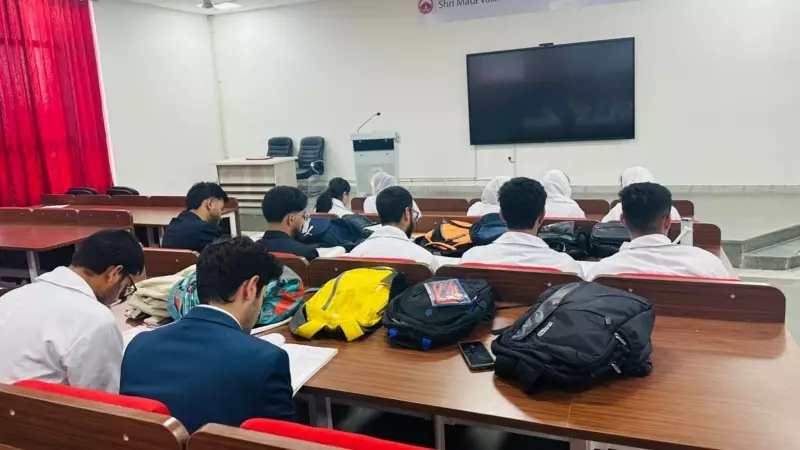
While right-wing groups protest outside, a sense of focused calm prevails within the campus of the Shri Mata Vaishno Devi Institute of Medical Excellence in Katra. The institute's first batch of 47 MBBS students, a majority of whom are Muslim students from Kashmir, has been attending classes peacefully for over a month and a half, distancing itself from the external agitation.
Campus Life: Bhajans, Uniforms, and Village Visits
The atmosphere on campus, located 16 km from the famed Vaishno Devi shrine, is one of disciplined routine. The sounds of bhajans and hymns dedicated to the Goddess play in common areas, under the gaze of large photographs of the deity. The batch of 47 includes more than half women, and students follow a prescribed uniform—a rarity in Jammu and Kashmir colleges—alongside strict attendance and campus exit policies.
Officials confirm that of the 50 students initially selected through the J&K Board of Professional Entrance Examination based on NEET scores, 44 are from the Kashmir Valley and have all joined. Interestingly, of the six selected from the Jammu region, only three took admission. Authorities attribute this primarily to the cost, with annual tuition fees at Rs 4.95 lakh plus over Rs 50,000 in miscellaneous charges and a one-time fee of Rs 51,000.

"We are here to study, and to serve the people," said a student, reflecting the general sentiment. The curriculum includes mandatory fortnightly visits to the adopted village of Penthal, 3 km away, where each student provides medical check-ups to three allotted families. "Whenever we visit, we are offered tea or lunch," shared a female student from Kashmir.
Protests Persist Outside the Gates
The protests, led by a conglomerate called the 'Shri Mata Vaishno Devi Sangharsh Samiti' which includes the VHP, Bajrang Dal, Shiv Sena, and J&K Sanatan Dharam Sabha, demand that admissions at the shrine-funded institute be restricted to Hindus. Backed by BJP Udhampur MLA R S Pathania, they argue that an institution built with devotees' offerings should prioritize Hindu students.
However, officials clarify that as the institute is not classified as a minority institution, such reservations are not legally possible. Colonel (retd) Sukhbir Singh Mankotia, president of the Samiti, claims the lack of interest from Jammu students is due to fear. "Reports about the involvement of doctors from Kashmir in terror attacks and allegations of 'love jihad'... have created an atmosphere of scare among parents," he stated.
A Pattern of Integration and Future Focus
Within the broader Shri Mata Vaishno Devi University, which houses the medical college and 15 other departments, nearly 2,800 students study together. Only about 20% are Muslims from Kashmir, with the rest coming from across India from diverse communities. A senior official noted no issues among students who live and study together, despite different religions, languages, and eating habits. Even the undertaking prohibiting non-vegetarian food on campus has seen no pushback.
The trend of Kashmiri students dominating medical seats in the Jammu region is not new. While Jammu has more medical seats (900) than Kashmir (675), students from the Valley have been filling most of them in recent years—a reverse of the trend seen in engineering admissions.
Students feel secure, citing regulated entry and hospitable surrounding villagers. Most return to the Valley on the Katra-Srinagar Vande Bharat Express every fortnight, leaving Saturday and returning Sunday evening. As one student summed up, "With entry and exit regulated by campus staff and the surrounding villagers exceedingly hospitable, we cannot have a more secure environment." The academic harmony inside the campus continues, even as the distant noise of protests lingers.