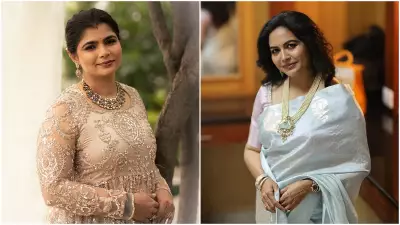
Between a packed rehearsal schedule, shoots for films and digital projects, her YouTube series, and life as a hands-on mother, actor Girija Oak Godbole moves through her days with surprising ease. Balance, she says, is not about choosing one role over another, but about letting everything coexist. Recently propelled into the social media spotlight by a viral reel, Girija reflects on the fleeting nature of online fame, the illusion of control in creative work, and why theatre remains her truest anchor.
A Candid Conversation on Art and Life
In a candid conversation during her visit to Bengaluru, she speaks about art, anonymity, politics, parenting, and the confidence that comes from knowing who you are — on and off stage.
The Thrill of Theatre and the Illusion of Control
Q: You’ve often spoken about your love for theatre. What is it about being on stage that excites you so much?

Theatre is a very strange and thrilling space. When you’re on stage, you’re aware that every word is being heard, every movement matters. That might sound intimidating, but for me, it feels safe. Even if I don’t know exactly what I’m going to say in the next moment, I trust the space. I actually find it fascinating that there’s a term called stage fright, because I love being on stage. I prefer a live audience to staring into a single camera for films or series. What excites me most is the control — or at least the illusion of control.
In cinema, you’re never entirely responsible for the final outcome. Editing, music, camera angles, and reactions chosen later shape your performance. On stage, there’s none of that. No edit can save you. No background score can elevate you. You’re completely exposed. If you miss your mark or the light doesn’t fall right, you still have to make it work. It’s challenging — and that’s exactly why it’s exhilarating.
Navigating Social Media Fame and Artistic Integrity
Q: You mentioned control. That seems central to how you look at life and work.
It is, but control is often misunderstood. You can only control what you do — not how it’s received. In our industry, there’s the work you put out and then the response to it. People often confuse control with controlling outcomes, which is pointless. I recently gained significant visibility due to a reel. But before that, I’d spent years doing plays in difficult venues, working through technical failures, and navigating hardships. Something completely unexpected went viral — that’s life today. So for me, control is about choice, not applause.
The stage offers a brief, make-believe illusion of control. Once I step on it, I’m on my own. For that suspended moment, I get to decide how I live this alternate reality. And then it vanishes. In real life, control doesn’t exist the way we imagine it does.
Q: Has social media visibility changed the kind of work coming your way?
Two things have happened. One, I’m getting better endorsement deals. But I’ve never set out to be an influencer. I come from a generation where that wasn’t even a career option. That said, these collaborations allow me to sustain the work I deeply care about — experimental and parallel theatre, intimate performances, projects that aren’t commercially lucrative. They’re workshops for the soul as an actor, but you can’t survive on them financially. So the balance works. Endorsements aren’t the goal; they’re enablers.
Current Projects and Artistic Priorities
Q: What projects are you most excited about right now?
I’m part of a play written by Padmashri award-winning Marathi playwright Satish Alekar — one of the most respected voices in Marathi literature. His writing is surreal, absurd, deeply metaphorical, and political. The play, Thakishi Samvad, is extremely experimental. I’m also considering a small, non-commercial film I really want to do. But we all have responsibilities — homes, families, children. If one day of commercial work allows me to spend five days doing meaningful artistic work, that trade-off makes sense.
Dealing with Criticism and Online Negativity
Q: You faced criticism for interviewing political leaders. How did you deal with that?

There’s a clear difference between promoting a political candidate and interviewing an elected representative. I’ve never campaigned or participated in rallies. But speaking to someone already in office allows me to question them — about infrastructure, water, traffic, urban planning. These are civic issues. Yes, I received flak. People unfollowed me. But I was clear about my intent, and that clarity matters more to me than approval.
Q: How do you handle online negativity and trolling?
I won’t pretend it doesn’t affect me — it does, briefly. But I genuinely feel sad for people who take joy in being cruel anonymously. I’ve never encountered such behaviour face-to-face. Anonymity gives people a courage they wouldn’t otherwise have. When morphed images of me were circulated, I chose to speak about it. Silence didn’t feel right. I’m not the first person this has happened to, and I won’t be the last. But if speaking up helps even a little, it’s worth it.
Parenting in the Digital Age and Personal Philosophy
Q: Do you see social media fame as fleeting?
I don’t think of it as a bubble — it’s more like a wave. Waves rise and recede. This is a big one, yes. Maybe another will come, maybe it won’t. But my relationship with my work stays the same. I live to tell stories — on stage or on screen — regardless of how many people are watching.
Q: You’re raising a child in the age of social media. How do you navigate that?
My son goes to a Waldorf-inspired school that prioritises internal development and limits early exposure to screens. He wasn’t introduced to social media or the internet too young. He got his phone only recently, at 13, and for practical reasons. When all this attention happened, he asked me, “Are you going to change as a person?” That question stayed with me. It reaffirmed why grounding matters. Validation shouldn’t come from anonymous strangers, but from people you know—and from yourself.
Q: You often use humour and self-parody online. Is that deliberate?
Very much so. I take my work seriously, but not myself. The moment you start taking yourself too seriously, ego takes over, tolerance shrinks, and growth stops. Our field is collaborative — you can’t survive alone. Humour keeps me open, human, and easier to work with.
Q: Is it easy to make friends in the industry?
It’s easy to make friends anywhere if you’re open. Yes, competition exists, especially among people of similar age groups. Rejection stings—it’s human. But there’s enough work today. Platforms have expanded; everyone will find their space. Also, my work doesn’t define me entirely. I have a full life outside it—my son, family, friends, travel, food, conversations. When work is just one part of your life, setbacks don’t consume you.
Q: That seems to be your core philosophy.
Exactly. No single aspect — work, fame, or relationships — should become your entire world. Everything has to coexist. That balance is what keeps me grounded, joyful, and sane.