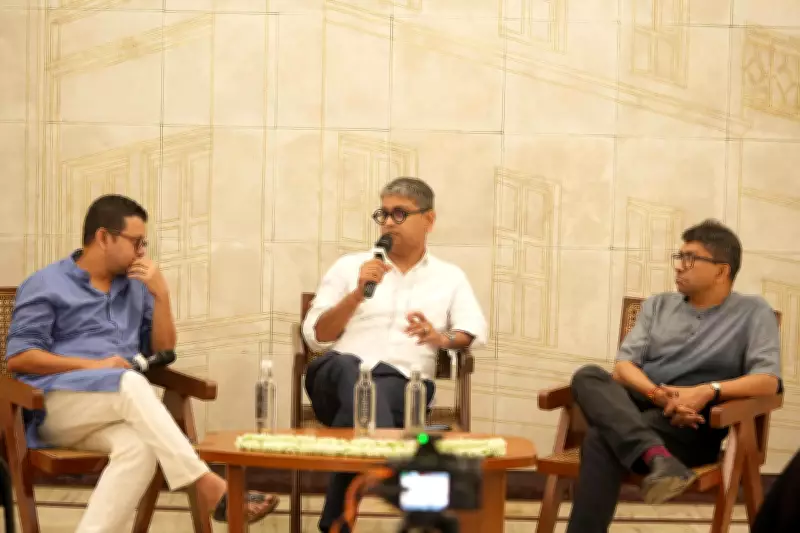
Questions of home, displacement, memory, and belonging took center stage at Experimenter Outpost at Alipore Museum on Saturday as architect Abin Chaudhuri and artist Rathin Barman came together for a conversation around Barman's solo exhibition The Cage Broke, And I Found the Horizon. The discussion was moderated by Prateek Raja, director of Experimenter.
Exhibition Overview
The exhibition, currently on view at Experimenter Outpost, marks Barman's first solo exhibition in Kolkata and brings together a new body of work comprising paintings, sculptures, and drawings. Through these works, the artist examines the idea of home not as a fixed structure but as a constantly evolving entity shaped by migration, memory, and lived experience.
Artist's Perspective
Reflecting on the exhibition's central premise, Barman said, "For me, home is not a fixed structure. It is something that travels with us through memory, migration and experience." He added that the exhibition seeks to explore how people continue to carry fragments of places they have left behind while creating new identities and attachments elsewhere.

Title and Themes
The title of the exhibition itself reflects a tension between confinement and liberation. It references both personal and collective histories while drawing connections to Kolkata's urban landscape and the history of Alipore Jail, once one of Asia's largest prisons and now a museum. According to the exhibition note, the project also engages with themes of movement and displacement that emerged during India's Independence movement and continue to resonate through contemporary patterns of migration.
"The title speaks to a journey from confinement to possibility," Barman noted. "It is about imagining freedom beyond physical and psychological boundaries, and about finding new horizons even in moments of uncertainty."
Artistic Practice
At the heart of Barman's practice is an exploration of changing notions of dwelling. His sculptural works investigate the possibilities of life in old, decaying, and abandoned structures, as well as the memories embedded within them. The exhibition reflects on the experiences of families who migrated from East Bengal after Partition, those who settled in the industrial fringes of Kolkata, and newer waves of migration that continue to reshape the city. The works draw attention to the social, political, and economic challenges that accompany the search for shelter and stability. Rather than treating home as a static destination, Barman presents it as a fluid space of negotiation and transformation, where histories, aspirations, and identities intersect.
Architecture and Memory
Discussing the relationship between architecture and memory, the artist said, "I am interested in the lives that remain embedded in abandoned buildings. Even when people leave, their presence continues to shape a space." He suggested that structures often become silent repositories of personal histories, preserving traces of those who once inhabited them.
Exhibition Note
The exhibition note describes home as a "living organism" that extends beyond its physical boundaries. Barman's sculptures and installations reimagine architectural forms as repositories of memory, capturing traces of lives lived and left behind. Through fragmented structures and reconstructed spaces, he invites viewers to reflect on what it means to belong in a rapidly changing urban environment.
Conversation with Architect
The conversation with Chaudhuri, founder and principal architect of Abin Design Studio, expanded on these themes by bringing together perspectives from contemporary art and architecture. The dialogue examined how cities evolve through migration, how built environments absorb human histories, and how architecture can act as both a witness to and a participant in social change.
Kolkata's Urban History
Speaking about Kolkata's layered urban history, Barman observed, "Kolkata is a city built through movement—through arrivals, departures and resettlements. Those histories continue to shape the way we understand belonging, community and home."