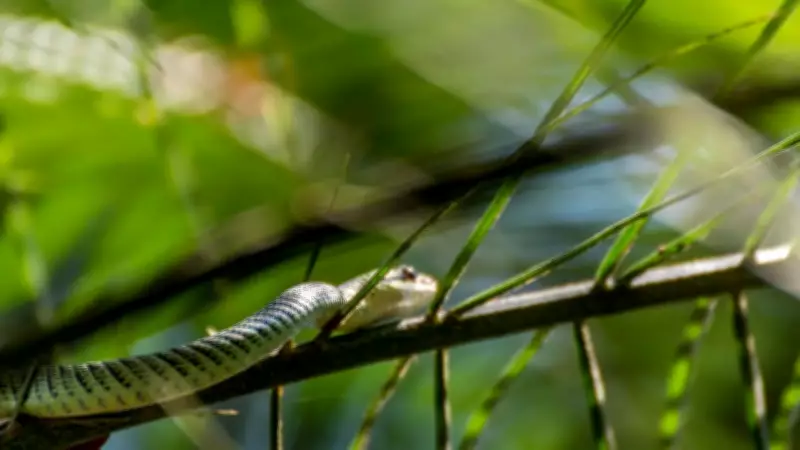
Some animals instantly make people stop and ask, “Wait, is that even real?” Flying snakes are one of them. Every now and then, videos of these reptiles gliding from one tree to another pop up online and leave people stunned. Most assume the footage is edited because, let's face it, snakes are supposed to slither on the ground, not sail through the air. But flying snakes do exist.
Found in parts of South and Southeast Asia, these snakes have developed an unusual way of moving around. They don't have wings, and they don't fly like birds, yet they can glide from tree to tree with surprising ease. Scientists have been studying them for years, and the more they learn, the more fascinating these reptiles seem. Here are five surprising facts about flying snakes.
They Don't Actually Fly
The name “flying snake” can be a little confusing. These snakes don't flap wings or soar across the sky. Instead, they glide. A flying snake climbs high up a tree, launches itself from a branch, and glides towards another tree. While the glide lasts only a few seconds, it can cover a considerable distance. Some species can travel up to 30 meters in a single glide, allowing them to move through forests without coming down to the ground very often.

Their Bodies Change Shape in Mid-Air
This is perhaps the most unusual thing about flying snakes. Just before gliding, the snake spreads its ribs and flattens its body. Instead of looking round like a typical snake, it becomes flatter and wider. This change in shape helps the snake stay in the air longer and move more smoothly. Scientists say this ability is one of the reasons flying snakes are so efficient at gliding despite having no wings at all.
They Move Through the Air in an S Shape
Flying snakes don't remain still while gliding. As they move through the air, they continuously wave their bodies in an S-shaped motion. This movement helps them stay balanced and control their direction. That's why they don't simply drop from one tree to another. They can steer themselves and make adjustments while gliding, something that continues to fascinate researchers studying their movements.
They Spend Most of Their Lives in Trees
Flying snakes are excellent climbers and are rarely seen on the ground. They spend most of their time high up in trees, where they hunt, rest, and travel. Gliding is actually an efficient way for them to move around because it allows them to cover larger distances without having to crawl down one tree and climb another. It also helps them explore new areas and move around the forest canopy quickly.
There Are Only Five Species of Flying Snakes
Despite all the attention they receive online, flying snakes are actually a small group. Scientists recognize five species belonging to the genus Chrysopelea. These snakes are found across countries, including India, Sri Lanka, Thailand, Malaysia, Indonesia, and the Philippines. Many of them are brightly coloured, with shades of green, black, and yellow that help them blend into leaves and branches. Their striking appearance and unusual abilities have made them one of the most fascinating reptiles in the animal kingdom.
For most people, the idea of a flying snake still sounds unbelievable. But hidden high in the forests, these reptiles continue to do something that seems impossible at first glance – glide effortlessly through the air, proving once again that nature rarely runs out of surprises.