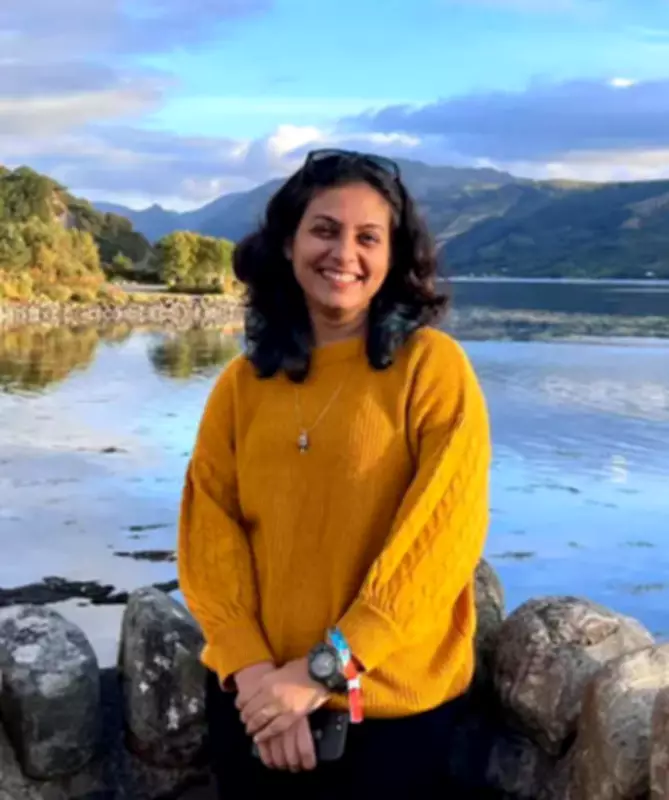
Nearly a decade ago, conservationist Parveen Shaikh began working on protecting the flame-billed Indian skimmer, an endangered species of riverine bird found in the Chambal region which had dwindled to just 400. With the help of a community of 'nest guardians', Shaikh worked to increase the bird count, which has won her the Whitley Award or 'Green Oscars'. She speaks to Shruti Sonal about the efforts and the changing fate of rivers in the age of extreme heat.
What got you interested in the conservation of Indian skimmers?
When I joined the Bombay Natural History Society in 2012, I realised that I'd like to work on threatened bird species. I came across the Indian skimmer, and found it to be beautiful and unique, especially because of the shape of its bill. But when I dug deeper, I realised we know very little about it. There existed a lot of information gaps...why their population was declining, how the birds nested, and whether there was a problem in nest survival? That was one of the reasons I started work on skimmers, conducting my first survey on the Chambal River in December 2016. I realised that there was a loss of nests because of predation and trampling and there should be some intervention to stop this. That's when the idea of involving community members and experimenting with some protection or guarding scheme for the nests came up. Nest survival has nearly doubled since then, rising from 14% to 27% and bird count is over 1000, a direct result of community involvement and scientific monitoring.
What were the challenges when you first tried to involve the community?
Most community members that we worked with knew about ghariyals and magarmach, but they had little clue about the skimmer or what was special about it. However, they helped with patrolling of sites or just sharing their understanding of life around the river right from the start. Many of them also helped out as field assistants because it was a completely new territory for us. It was just before Covid hit that we thought of asking community members to form groups and protect the nesting colonies. The work could only begin in 2022. We convinced the community members that this would be a source of seasonal employment for them. The results weren't positive right from the start. It took patience and there was a lot of R&D that went in. In a couple of nesting colonies, more than 60% of the birds survived successfully by just guarding their nests and not letting any predator in. We then understood that this model has potential and could be scaled. Other challenges included heavy boat traffic, fishing activity, religious practices along the riverbank, sand mining and urban pollution that increases pressure on nesting colonies. We have also recently installed predator-proof fencing and GPS mapping for real-time monitoring of nests.

You now propose to replicate that model on other rivers, including the Ganga and the Yamuna. Will the award help in that pursuit?
The results from Chambal are quite good. The population shows an increasing trend. More than 90% of skimmer's global population breeds in India. And Chambal has a very large, significant population in the country. But there are other rivers also where there are bird nests, and they also have problems. We want to support this bird by protecting the most vulnerable nesting colonies from predation. The Whitley Award is going to help us to scale up. We also have support from the National Mission for Clean Ganga, and are planning to replicate some principles of the Chambal model, tailoring it for Prayagraj or other sites on the Yamuna River. At Prayagraj, the project will cover sites where birds face pressures from human disturbance, boat traffic, fishing, and pollution. Local guardians will be given incentives for their conservation service to provide a vital source of income while fostering stewardship.

How do extreme heat and climate change impact riverine ecosystems?
As our population increases, so does the demand for water. That brings rivers under pressure, and every year, several schemes for water extraction are proposed on them. One thing that's very crucial for riverine ecosystems is a minimal flow rate in the river, so that it keeps the rivers alive in order to support not only skimmers, but also other species like gharials, crocodiles, and turtles. Heat waves further endanger their survival. For instance, these heat waves clash with the peak hatching season of the skimmers, making it very difficult for the birds to survive. There is a very hot sandbar where they nest, and they have to keep cooling their eggs and chicks. If they are not able to do it and the temperatures are too high, these eggs will break, and the chicks will not survive.
There's concern about how massive AI data centers are going to exacerbate the water crisis. As a conservationist, do you propose any safeguards for riverine species?
We need to find a balance between the requirements of people and those of other species. It's very difficult to do, but we really need to pour more efforts into finding out what the required minimum flow rate of rivers is, not only for the survival of skimmers but also for other species, especially during the peak summer season.