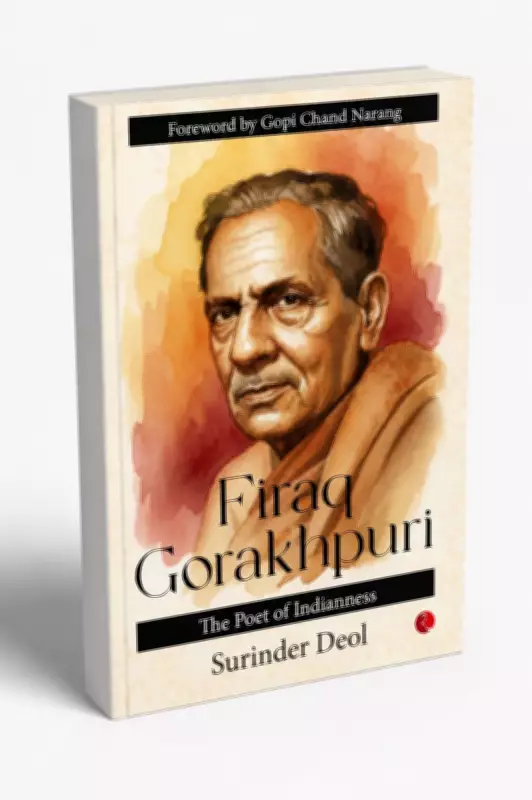
Firaq Gorakhpuri, one of the most profound poets in Urdu literature, is the subject of a new book by Surinder Deol titled 'Firaq Gorakhpuri: The Poet of Indianness'. Published by Rupa, the 383-page volume aims to establish Firaq's true place in Urdu poetry for both scholars and general readers.
A Poet Rooted in Indian Soil
Firaq was a poet born out of Indian soil, deeply rooted in its history, culture, and traditions. An English scholar, a student of Sanskrit, and widely read in logic, ethics, philosophy, and world history, his sensibility was of a very high order. Such depth was not easily grasped. His poetry reflects the spirit of Satyam, Shivam, Sundaram, drawing from both the romantic sensibility of English poetry and the metaphysical depth of Sanskrit thought. His verse forms a quiet bridge between East and West, speaking equally to the heart and the mind.
Critics and Misunderstandings
His critics, especially traditionalists, often failed to understand this deeper music and vision. With their limited outlook, they labelled him a 'Hindu shayar'. The book notes that such has often been the fate of great minds like Socrates, Gandhi, and Ghalib — to be truly understood only after their time has passed. Firaq's poetry gives suroor — not a passing intoxication, but a lasting depth. His language may seem simple, but its meanings unfold in layers, taking the ghazal to rare heights.

As Firaq himself wrote: 'Wo aalam mujh par hota hai jab fikr-e-ghazal main karta hoon, / Khud apne khayalon ko, humdum, main haath lagate darta hoon.' (When a thought for a ghazal comes to me, I become like a man possessed. I tremble, fearing that even the slightest careless touch might shatter it.)
Language and Style
Firaq's language, a natural blending of Khadi Boli, Hindi and Urdu, flows freely, untouched by rigid ideology or dogma. For him, poetry remained pure, beyond narrow classifications. He wrote: 'Husn ko ek husn hi samjhe nahin, aur ai Firaq, / Mehrban, namehrban kya kya samajh baithe the hum.' (We could not see beauty as merely beauty, O Firaq — what all notions of kindness and cruelty we imposed upon it.)
The Book's Approach
Surinder Deol has done a careful job in selecting Firaq's verses. The book presents the ashaar in Roman and Devanagari scripts, along with English translations, offering a three-dimensional way of approaching each sher. This enriches the reader's experience. The rendering of such gossamer-like emotions and subtle thoughts into English is almost an impossible task, and it takes courage to attempt it. Surinder Deol does so with a fair measure of success.
As a personality, Firaq left a lasting impression. In mushairas, his baritone voice and striking presence would hold the audience spellbound. However, the book does not dwell much on his wit and humour — an aspect beautifully brought out earlier in Mushtaq Naqvi's 'Firaq ke Lateefey'.
Recognition and Legacy
The Government of India recognised his contribution with several awards, including a postage stamp issued in his name. The cover of this book thoughtfully uses the portrait from that stamp. Firaq's masterpiece 'Gul-e-Naghma' earned him both the Jnanpith Award and the Sahitya Akademi Award. His other important works include 'Gul-e-Rana', 'Rooh-e-Kainaat', 'Roop', 'Mashaal', 'Shabnamistan', 'Shola-e-Saaz', 'Ramz-o-Kinayat', and 'Hindola'.
Ganga-Jamuni Tehzeeb
Urdu poetry has been shaped by giants like Mir, Ghalib, Dagh, Momin, and Zauq. Yet Firaq stands apart. His poetry draws from Vedic imagery, Indian villages, and lived cultural experience. It carries within it the spirit of Ganga-Jamuni tehzeeb — inclusive and harmonious. His poetry feels like a bouquet of Indian flowers — the purity of the lotus and the fragrance of the rose — woven together in the delicate strands of Urdu. This fresh expression unsettled many traditional poets accustomed to fixed imagery. Yet Firaq was equally at ease with Islamic culture and shared a strong intellectual bond with poets like Josh Malihabadi. Intizar Husain rightly observed that with Firaq, the ghazal began a new journey; he was, in many ways, the guardian spirit of the new ghazal.

He used Hindi words and metaphors beautifully, especially in 'Rubais': 'Moti ki kaan, ras ka saagar hai badan, / Darpan akash ka sarasar hai badan, / Angdaai mein rajhans tole hue par, / Ya doodh bhara Mansarovar hai badan.' (Her body is a treasury of pearls, an ocean suffused with nectar-like sweetness. It serves as a complete mirror of the expansive sky. In the grace of her stretching form, she appears like a swan, her wings poised and measured for flight — or like Mansarovar, a tranquil lake filled with milky radiance.)
Life and Influence
A long-time professor at Allahabad University, Firaq qualified for the PCS and ICS, but resigned to join Mahatma Gandhi's Non-Cooperation Movement, for which he was imprisoned for 18 months. Gandhi is said to have described him as a 'spoiled genius of India', a remark that speaks as much of his brilliance as his restless individuality. Understanding Firaq is not easy even in simple Hindustani; translating him is an even greater challenge. Deol's book makes a sincere effort to bridge that gap.
The reviewer, Shabihul Hasnain, a former judge of the Allahabad High Court and an Urdu poet, concludes that no one can fully capture Firaq. His knowledge and vision were vast, placing him in a higher realm of Urdu poetry.