

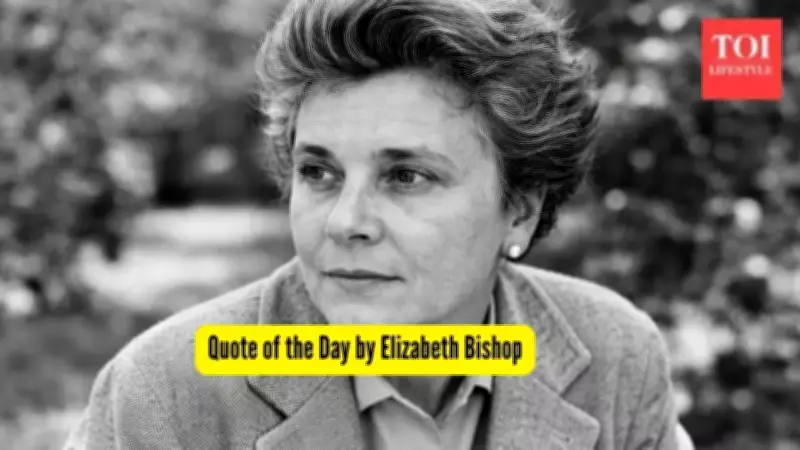
Elizabeth Bishop: A Legacy of Precision and Poetic Mastery
Elizabeth Bishop stands as one of the most original and influential poets of the 20th century, renowned for her clear, controlled writing, sharp observational skills, and ability to convey deep emotion through restraint. Despite publishing a relatively small body of work during her lifetime, her poetry has garnered critical acclaim and continues to resonate with readers and poets worldwide, shaping the landscape of modern literature.
Early Life and Formative Years
Born on February 8, 1911, in Worcester, Massachusetts, Bishop's early life was marked by significant upheaval and loss. Her father died when she was an infant, and her mother suffered from severe mental illness, leading to institutionalization when Bishop was just five years old. This instability resulted in a childhood spent moving between relatives across the United States and Canada, including Nova Scotia, where she developed a profound connection to the coastal landscapes that would later feature prominently in her poetry. These experiences often infused her work with themes of displacement and a longing for belonging.
Education and Literary Beginnings
Bishop attended Vassar College, where she began to pursue writing seriously. There, she co-founded a literary magazine and connected with influential writers. Upon graduating in 1934, she met Marianne Moore, who became a pivotal mentor, profoundly shaping Bishop's poetic approach. Moore's emphasis on accuracy, meticulous attention to detail, and emotional control left a lasting imprint on Bishop's work, fostering a style that prioritized observation over overt personal expression.

Travels and Artistic Evolution
As an adult, Bishop embraced a life of extensive travel, residing in various locales such as Key West, Florida, and most notably, Brazil. Her move to Brazil in the early 1950s proved transformative, both personally and artistically. She entered into a long-term relationship with Brazilian architect Lota de Macedo Soares, and the vibrant landscapes, culture, and daily life of Brazil deeply influenced her poetry and prose. Unlike many of her contemporaries who favored confessional styles, Bishop focused on detailed descriptions and vivid imagery, allowing emotion to emerge subtly through careful observation.
Key Themes and Poetic Style
Bishop's poetry often begins with ordinary objects or scenes—such as a caught fish, a waiting room, or a map—and unfolds to reveal deeper insights into identity, loss, and the human condition. Her renowned poem "The Fish" exemplifies this approach, starting with a precise, almost scientific depiction of a captured fish before transitioning into a moment of epiphany and release. Another standout, "One Art," a villanelle about loss, showcases her mastery of form and ability to express profound feelings without sentimentality. Her work is characterized by its quiet, controlled tone and a deep respect for life's complexities.
Geography and Place in Her Work
A significant aspect of Bishop's poetry is her engagement with geography and place. Many of her poems are set in specific locations, from the coasts of Nova Scotia to the tropics of Brazil and urban areas in the United States. These settings are not mere backdrops but active elements that explore themes of self-perception and connection. Her fascination with maps, travel, and borders reflects a broader interest in how individuals navigate their place in the world.
Awards and Recognition
Despite her limited output, Bishop received substantial acclaim during her lifetime. Her collection North & South earned the Pulitzer Prize for Poetry in 1956. She served as the Poet Laureate Consultant in Poetry for the Library of Congress from 1949 to 1950 and was honored with the National Book Award, underscoring the literary community's high regard for her contributions.

Enduring Influence and Legacy
Bishop's legacy is defined by the precision and impact of her work rather than its volume. She demonstrated that poetry could be both intellectually rigorous and emotionally resonant without resorting to dramatic flair. By emphasizing close observation of the external world as a path to self-understanding, she pioneered new avenues for descriptive and observational poetry. As a counterpoint to confessional poets, she proved that restraint and nuance can be as powerful as direct expression.
Her life and work have also played a crucial role in discussions of identity, particularly regarding gender and sexuality. Although she maintained privacy about her personal life, her long-term relationships with women have established her as an important figure in LGBTQ+ literary history.
Elizabeth Bishop passed away in Boston in 1979, but her poetry continues to be studied and cherished. Her words endure through their quiet strength, capturing the beauty and complexity of the world with unparalleled clarity.
Quote of the Day: Insights on Relationships
"One shouldn't get too involved with people who can't possibly understand one" is one of Elizabeth Bishop's most memorable lines. This statement offers a personal and cautionary perspective on relationships, emotional investment, and self-preservation. It suggests that meaningful connections require a degree of mutual understanding; without it, interactions can become strained, unfulfilling, or emotionally draining.
The phrase "too involved" is key here, implying that while interaction may be possible, deep emotional entanglement with those who lack comprehension should be avoided. True understanding in relationships demands empathy, perspective-taking, and openness to another's inner world. Absent these elements, individuals may feel unseen or isolated, even in company.
This line also highlights the importance of emotional boundaries. Becoming overly involved with someone incapable of understanding you can lead to repetitive explanations without being heard or sacrificing aspects of your identity to maintain the relationship, potentially resulting in self-loss and suppressed authenticity.
