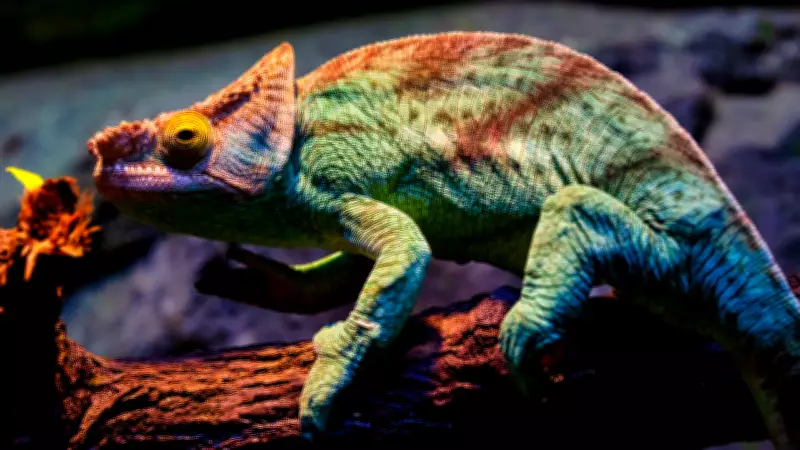
The Astonishing Speed of the Chameleon's Tongue
Nature consistently reveals marvels through its smallest creatures, with the chameleon standing out as a prime example. This small reptile, famous for its color-changing ability, possesses one of the fastest biological mechanisms in the natural world: its tongue. Capable of stretching out, grabbing prey, and retracting within mere seconds, this feat raises profound questions about evolutionary biology and biomechanics.
Record-Breaking Acceleration: 60 MPH in 0.01 Seconds
The chameleon's tongue achieves speeds of up to 60 miles per hour within an astonishing 0.01 seconds. This acceleration surpasses that of many high-performance sports cars, highlighting an extraordinary natural engineering. Such rapid movement allows chameleons to capture insects with remarkable efficiency, a critical survival trait in their ecosystems.
Research from Current Biology underscores this capability. A study titled "Convergently Evolved Linear Actuators in Ballistic Tongues" reveals that small chameleon species produce "extremely high power output during tongue projection, exceeding that of any known vertebrate muscle." This means their tongues generate more power than any other animal's muscular system, a testament to evolutionary specialization.

Biomechanical Secrets: Elastic Recoil Over Muscle Contraction
Unlike humans, who rely solely on muscle contractions for movement, chameleons utilize a sophisticated system of elastic properties. Their tongue functions as a spring-loaded mechanism, where elastic tissues store energy that is suddenly released, propelling the tongue outward. This process, known as elastic recoil, is a key focus in biomechanics studies.
The reliance on elastic recoil rather than muscular contractions enables rapid tongue projection. Additionally, a specialized adhesive suction cup at the tongue's tip aids in gripping insects securely, ensuring successful captures even at high speeds.
Survival Advantages and Evolutionary Significance
This incredible tongue speed provides chameleons with significant survival advantages. Insects are often fast and easily startled, making quick capture essential. By waiting patiently and striking with precision, chameleons conserve energy—a crucial benefit in environments where food resources may be scarce.
Interestingly, smaller chameleons project their tongues faster than larger ones, allowing them to compete effectively despite their size. This adaptation underscores the evolutionary pressures that shape such remarkable traits.
Inspiration for Robotics and Engineering
Beyond biology, the chameleon's tongue has inspired advancements in robotics and engineering. Scientists study its mechanisms to develop machines that utilize stored energy for fast, efficient movements. This cross-disciplinary research highlights how natural designs can inform technological innovation.
In summary, the chameleon's tongue is far more than a curious biological feature. It represents a pinnacle of natural engineering, achieving speeds of 60 mph within 0.01 seconds through elastic recoil. This ability not only ensures survival but also offers insights into fields ranging from biomechanics to robotics, showcasing the profound interconnectedness of nature and science.