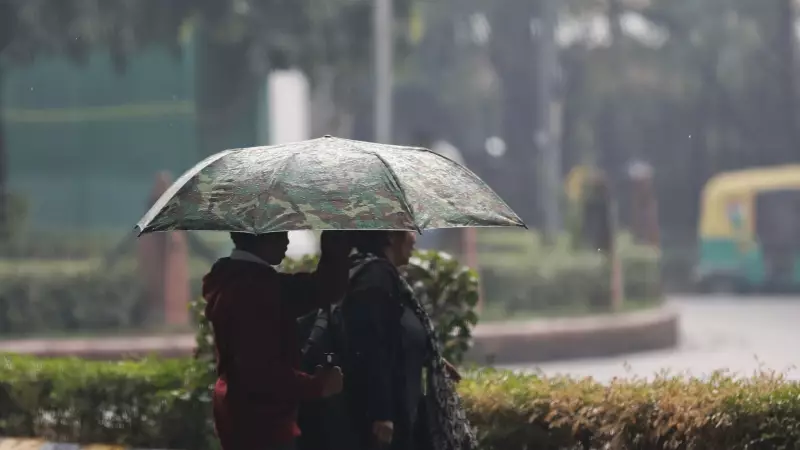
Despite experiencing rainfall across various parts of the city, Delhi witnessed a significant deterioration in air quality on Tuesday, plunging into the 'Very Poor' category. The Capital recorded an Air Quality Index (AQI) of 336, marking a sharp increase from Monday's AQI of 241, which was in the 'Poor' range.
Rainfall Fails to Improve Air Conditions
Delhi and the National Capital Region (NCR) experienced a fresh spell of rainfall on Tuesday morning, accompanied by light thunderstorms and lightning that continued into the evening. However, this weather event did not provide the expected respite from foul air, as pollutants remained trapped in the atmosphere.
Similar Trends in NCR Cities
The decline in air quality was not limited to Delhi alone. Noida saw its AQI deteriorate from 219 in the 'Poor' category on Monday to 331 in the 'Very Poor' category on Tuesday. Meanwhile, Gurgaon experienced a dip from the 'Poor' to the 'Very Poor' category, with its AQI rising from 276 on Monday to 306 on Tuesday.

Rainfall Measurements Across Stations
As of 5:30 pm on Tuesday, Safdarjung station in Delhi recorded 4.2 mm of rainfall. Gurgaon received 3 mm, while Ghaziabad recorded 3.5 mm. The maximum rainfall for the day was observed at the Palam station, which recorded 14.6 mm.
Weather Forecast and Historical Context
The India Meteorological Department (IMD) has forecast a generally cloudy sky with no rainfall for Wednesday. Additionally, cold wave conditions are likely to prevail over Gurgaon and Faridabad. The maximum temperature recorded on Tuesday evening was 16.9 degrees Celsius, with a minimum of 8 degrees Celsius, both within the normal range.
This decline in air quality follows a period of improvement last week. After rainfall on January 24, Delhi recorded an AQI of 184 in the 'Moderate' category. Prior to this, the city had last seen air quality in the 'Moderate' range on October 31, 2025, with an AQI of 163, largely due to strong winds that aided pollutant dispersion.
Expert Insights on Winter Pollution
According to environmental experts, factors such as winter conditions, thermal inversion, and calm winds typically hamper the dispersion of pollutants in the Delhi-NCR region during January. These conditions often lead to the accumulation of harmful particles in the air, despite occasional rainfall.
The persistent 'Very Poor' air quality highlights the ongoing challenges in managing pollution levels in the national capital, even with intermittent weather interventions.