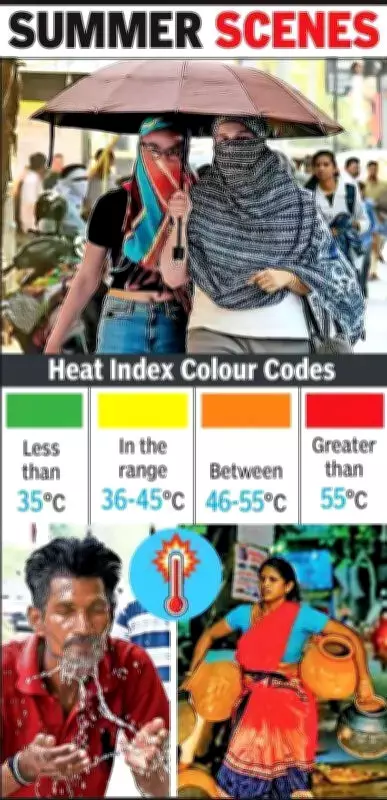
Nagpur: The India Meteorological Department (IMD) has introduced an experimental heat index aimed at better capturing the actual heat stress felt by people, particularly in regions like Nagpur and across Vidarbha, where perceived temperatures often exceed recorded values.
The heat index provides information on the impact of humidity on high temperatures and thus gives a ‘feels-like temperature', which can be used as an indication for human discomfort. It provides guidance towards additional care to be taken by people to reduce discomfort. Colour codes are used for the experimental heat index.
Many times, temperatures feel much hotter but actual readings by the weather department are on a lower side. Within the city too, temperatures vary and citizens may feel like a heatwave while it is not declared so.

The new index combines air temperature and relative humidity to reflect how hot conditions feel to the human body. Traditionally, heatwaves in India are defined using temperature thresholds or deviations from established norms such as the ‘pentad normal' — long-term weather data calculated on 5-day intervals. However, officials say, these measures do not fully account for humidity, which significantly amplifies discomfort.
Speaking at an interactive session on Heatwaves, Health Risks & Weather Reporting, organised by Regional Meteorological Centre Nagpur in collaboration with Patrakar Club of Nagpur and Asar Social Impact Advisors, IMD forecasting officer Praveen Kumar said, "The heat index, or ‘feels-like temperature', gives a more realistic picture of heat stress by factoring in humidity along with temperature."
The other speaker Dr Pradeep Awate, former state surveillance officer, Maharashtra health services, pointed to the growing impact of Urban Heat Island (UHI) effect. "In cities like Nagpur, densely built-up areas can be 4-5°C hotter than surrounding rural regions," he said.
Localities such as Itwari, Mahal, or Lakadganj face higher heat exposure due to dense construction and limited green cover, while areas like Seminary Hills remain relatively cooler, he said. Awate also noted that rising night temperatures, especially in informal settlements with tin or asbestos roofs, prevent adequate cooling, increasing health risks.