

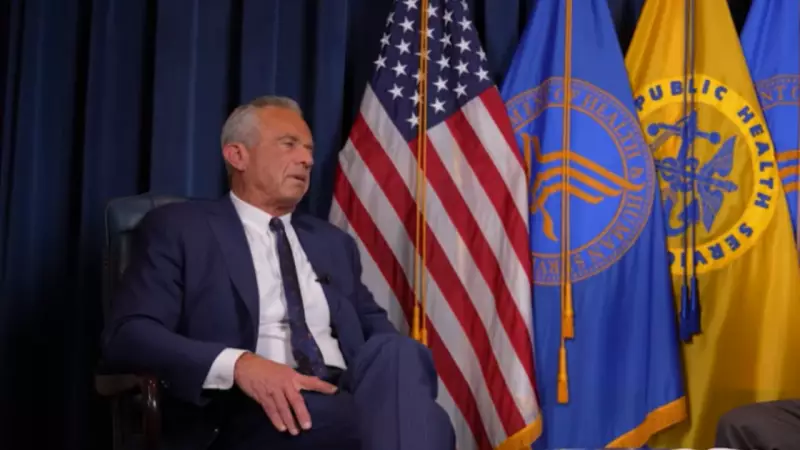
Federal Government Grapples with Cellphone Radiation Concerns
For years, discussions about cellphone radiation risks remained mostly on the internet's fringes. This week, those concerns entered the federal government's mainstream. Health and Human Services Secretary Robert F. Kennedy Jr. has publicly sounded alarms about 5G towers and cellphone radiation. He believes electromagnetic radiation presents serious health dangers including cancer and DNA damage.
Kennedy Voices Strong Personal Concerns
Kennedy made his position clear in an exclusive interview with USA TODAY. He participated in their "Extremely Normal" series. For him, worries about 5G and cellphone radiation are not hypothetical.
"Generally speaking, electromagnetic radiation is a major health concern," Kennedy stated when asked specifically about 5G towers. "I'm very concerned about it."

He claimed extensive scientific backing supports his position. Kennedy pointed to "more than 10,000 studies" documenting harmful effects from electromagnetic radiation. These effects reportedly include cancer, tumor growth, and DNA damage.
"EMFs are bad depending on the pulse rates and the wave lengths," Kennedy explained. "Some of them are very bad."
Administration Actions and School Policies
His comments arrived just as his department launched a new study into cellphone radiation. This move reignited a debate that scientists say has already received extensive examination.
Earlier, the Department of Health and Human Services highlighted cellphone restrictions in schools. This action formed part of the administration's "Make America Healthy Again" movement. According to the department, twenty-two states have limited cellphone use in schools to protect children's health.
However, those policies primarily target different concerns. They aim to reduce mental health impacts from social media, curb cyberbullying, and limit constant online engagement. They do not address exposure to electromagnetic radiation specifically.
Since 2022, K-12 schools across the United States have increasingly banned phones in classrooms. These decisions stem from behavioral and psychological reasons, not radiation concerns.
FDA Quietly Removes Older Safety Guidance
The interview coincides with federal agencies signaling a shift in tone. The Food and Drug Administration operates under Kennedy's leadership. It has removed older webpages that previously stated cellphones are not dangerous.
Andrew Nixon, a spokesperson for HHS, explained this action in a statement.
"The FDA removed webpages with old conclusions about cell phone radiation while HHS undertakes a study on electromagnetic radiation and health research," Nixon said. "This will help identify gaps in knowledge, including on new technologies, to ensure safety and efficacy."
According to The Wall Street Journal, HHS now plans to research possible health effects from radiation emitted by cell phones. The administration has not released new scientific evidence prompting this change. This raises a crucial question about what existing science actually says.
What Does Scientific Research Show?
Large-scale international research has repeatedly found no clear link between cellphone use and cancer. In September 2024, the World Health Organization published a comprehensive review in the journal Environmental International. Experts from nine countries analyzed sixty-three studies on cellphone use and cancer conducted between 1994 and 2022.
The researchers found no connection between cellphone use and brain cancer, the WHO reported.
That conclusion aligns with earlier global assessments. In 2011, the International Agency for Research on Cancer classified radiofrequency waves as "possibly carcinogenic to humans." IARC is part of the WHO. However, the agency did not identify a causal link. It placed cellphone radiation in the same broad category as items like pickled vegetables and coffee at that time.

Some laboratory studies in rats have suggested a possible association between radiofrequency radiation and cancer. But scientists consistently caution that those findings do not easily translate to humans. Human studies remain limited, inconsistent, and difficult to replicate at meaningful exposure levels.
The federal government's renewed focus contrasts with established scientific consensus. Kennedy's strong personal views and administrative actions have thrust this long-debated issue back into the national spotlight.
