

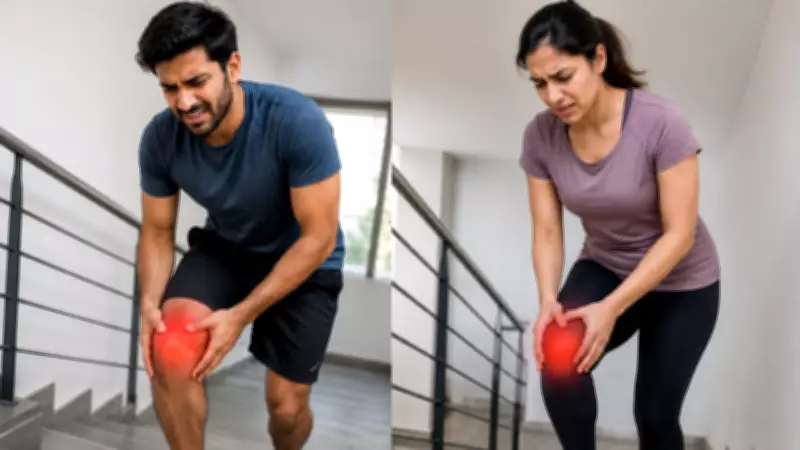
Knee pain is increasingly affecting individuals in their 30s, with doctors highlighting that discomfort while using stairs, particularly when going down, could be an early indicator of joint problems. This condition, once considered an old-age issue, is now common among younger adults due to prolonged sitting, low activity levels, and sudden intense exercise.
The Stair Descent Red Flag
Dr. Parag Sancheti, Orthopedic Surgeon and Chairman of Sancheti Institute of Orthopedics and Rehabilitation, emphasizes that pain during stair descent is a clinically significant warning sign. This discomfort often indicates early cartilage stress behind the kneecap, known as patellofemoral syndrome. Studies show that patellofemoral pain affects 3% to 6% of younger adults, with females accounting for 55% of cases. Importantly, this condition can progress to patellofemoral osteoarthritis if left unaddressed, leading to serious joint damage in later years.
Stiffness After Sitting
A second warning sign is localized stiffness in the knee after prolonged sitting. This tightness, which lasts for a few steps upon standing, is often linked to weak quadriceps muscles. When these muscles are weak, the knee joint lacks adequate support, forcing the joint surface to compensate and potentially leading to cartilage loss over time.

Clicking and Swelling
Clicking sounds in the knee, especially when accompanied by pain or a catching sensation, warrant evaluation. Dr. Sancheti notes that in his arthroscopy practice, he frequently finds early cartilage irregularities in patients who dismissed such symptoms. Swelling, even if mild, indicates inflammation and should not be ignored, as continuing activity through swelling can worsen the underlying condition.
Pain After Activity
Pain that occurs after exercise, rather than during, is another diagnostic clue. This pattern suggests joint overload, where the tissue tolerates activity temporarily but cannot recover. Such pain points to the need for rest and proper management.
Muscle Weakness as Root Cause
Quadriceps weakness is a common underlying factor in young patients with knee pain. These muscles act as primary shock absorbers; when weak, load transfers directly to cartilage. Dr. Sancheti has observed cartilage wear patterns in patients in their mid-30s that resemble those of individuals a decade older, emphasizing that early muscle strengthening can reverse damage.
Weight and Exercise Factors
Body weight significantly amplifies knee stress. Each kilogram of body weight translates to three to four kilograms of force through the knee during walking and up to seven to eight times during stair descent. Additionally, improper exercise techniques, such as deep squats without proper form or sudden high-intensity training, are common triggers for knee problems in health-conscious individuals.
Early Intervention Window
Early-stage knee problems are reversible, while late-stage damage is not. Dr. Sancheti notes that at his institute, many knee replacement patients first noticed symptoms a decade or more before seeking care. Physiotherapy, weight management, proper exercise technique, and quadriceps strengthening can effectively reverse early damage. Immediate evaluation is recommended if pain persists beyond two weeks, swelling is present, the knee feels unstable, or there is any sensation of locking or giving way.
Dr. Sancheti concludes: "Knee pain in your 30s is not a nuisance to manage. It is a signal from your body that something in the joint's load, alignment, or support needs correction. The window for non-surgical intervention is open. It will not stay open indefinitely. Act early."






