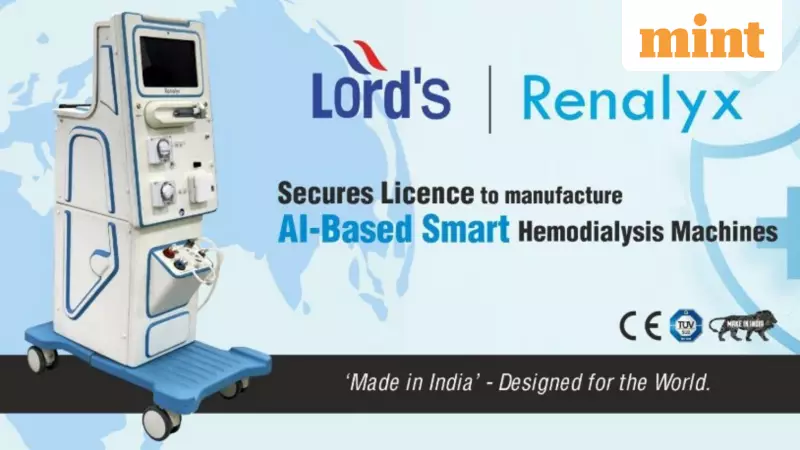
In a landmark achievement for India's medical technology sector, Lords Mark Industries Ltd. (LMIL) has secured a critical manufacturing licence from the country's top drug regulator. The company's venture, LMIL–Renalyx, has received formal approval from the Central Drugs Standard Control Organisation (CDSCO) to manufacture Class C AI-Based Smart Hemodialysis Machines domestically.
A High-Stakes Regulatory Milestone
Obtaining a licence for a Class C medical device is one of the most demanding regulatory feats in India's med-tech landscape. Class C devices are classified as high-risk and life-sustaining, where even a minor flaw can directly threaten patient safety. To clear this hurdle, LMIL–Renalyx had to demonstrate rigorous compliance with over 140 stringent parameters covering quality, safety, and risk management.
The exhaustive approval process includes validations for biocompatibility, electromechanical safety, sterility assurance, and complete traceability of every component. Furthermore, the company's manufacturing plant underwent multi-stage audits. The standards are so high that they are comparable to global benchmarks, which is why very few Indian manufacturers attempt this category.

Global Recognition and Domestic Impact
Parallel to the Indian licence, the LMIL–Renalyx dialysis system has also earned the globally recognized CE Marking. This certification indicates the product meets the European Union's health, safety, and environmental protection standards, granting it legal access to the European Economic Area (EEA). The company now joins an elite group of only six brands worldwide with this certification for dialysis systems.
This dual achievement—the CDSCO licence and CE Mark—arrives at a crucial time for India's healthcare infrastructure. The nation's dialysis market is valued at USD 5 billion in 2024, catering to an estimated 18–20 lakh Chronic Kidney Disease (CKD) patients. With 2.2–2.5 lakh new End-Stage Renal Disease (ESRD) cases emerging annually and treatment demand growing at 10–12% CAGR, the reliance on imported equipment has been a significant challenge. India currently has fewer than 6,000 dialysis centres.
The Technology Powering the Innovation
At the core of this development is the advanced AI-Based Smart Hemodialysis Machine, co-developed by LMIL and Renalyx. This platform is not a simple dialysis unit; it integrates artificial intelligence to drive automation, provide predictive safety alerts, optimise treatment protocols, and deliver real-time analytics. The goal is to minimise human error and enhance clinical precision for better patient outcomes.
To sustain this innovation, LMIL–Renalyx has built a robust research and development ecosystem focused on kidney and liver-care technologies, advanced sensing systems, and data-driven renal informatics.
Commenting on this pivotal milestone, Sachidanand Upadhyay, Managing Director of Lords Mark Industries Ltd., stated: "This licence is not just a regulatory approval, it’s a recognition of India’s ability to build and lead in the world’s most advanced med-tech categories. With our AI-Driven smart Hemodialysis Machine and continuous R&D team efforts, we aim to redefine renal care globally. Our mission is to create intelligent, safe, and accessible healthcare technologies from India that can serve the world."
By successfully navigating one of the toughest regulatory pathways and securing both domestic and international certifications, LMIL–Renalyx has laid a strong foundation. This move is poised to strengthen India's self-reliance in high-end medical technology, reduce dependency on costly imports, and ensure the country's growing dialysis infrastructure is supported by locally made, globally benchmarked equipment.