The world lost one of its greatest scientific minds on 18 April 1955, when Albert Einstein passed away at the age of 76 in Princeton Hospital. While his death marked the end of an era, it triggered a bizarre and controversial chapter concerning his physical remains, one that would unfold over the next four decades in direct contradiction to his explicit final wishes.
The Final Wishes and Their Violation
Einstein had been admitted to the hospital the previous evening with chest pain. He ultimately succumbed to a ruptured abdominal aortic aneurysm. True to his independent spirit, he had reportedly declined surgery, telling doctors he did not wish to prolong life artificially. His instructions for after his death were clear and simple: his body was to be cremated and his ashes scattered secretly. This was a deliberate attempt to prevent any site or relic from becoming a shrine to his memory.
These wishes were almost immediately disregarded. The autopsy was performed by Dr. Thomas Stoltz Harvey, the chief pathologist at Princeton Hospital. Despite having no specialization in neurology, Harvey took the extraordinary step of removing Einstein's brain during the procedure. He did not have permission from the Einstein family at that moment. In later years, Harvey gave conflicting reasons, from assuming consent to a sense of obligation to preserve the organ for science. Historical records confirm that no explicit consent existed when the brain was taken.

Harvey's actions did not stop there. He also reportedly removed Einstein's eyeballs, later giving them to the physicist's ophthalmologist, Henry Abrams. Days after the autopsy, Harvey sought retroactive approval from Einstein's eldest son, Hans Albert Einstein, who gave a reluctant, conditional agreement for scientific study. By then, the violation was complete. Harvey's refusal to hand over the brain to the hospital led to his dismissal, and he left Princeton, carrying one of history's most famous brains with him.
Decades of Improvised Custody and Scattered Research
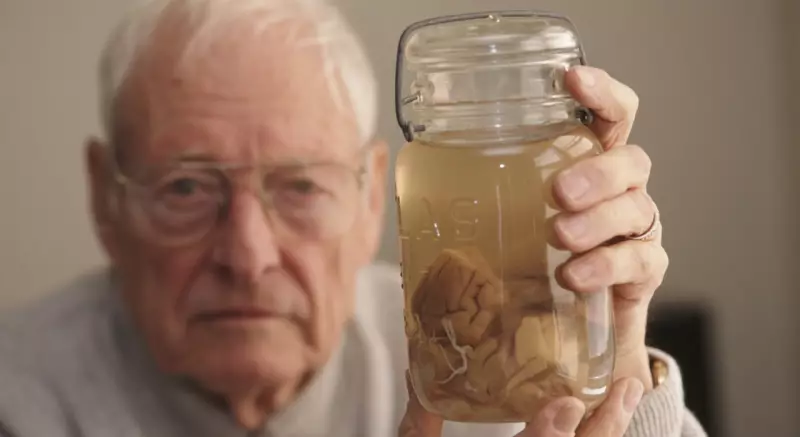
What followed was not a coordinated scientific inquiry but a strange, decades-long odyssey. Harvey photographed the brain, weighed it, and dissected it into roughly 240 sections. He preserved these pieces in jars, creating microscope slides stored without formal oversight. The brain travelled with Harvey across the United States, stored at times in a beer cooler, as he moved between jobs.
For nearly 30 years, little substantive research was published. The first major study emerged in 1985, led by neuroscientist Marian Diamond. It noted an unusual ratio of neurons to glial cells in parts of Einstein's cerebral cortex, hinting at a possible link to enhanced cognitive function. Media sensationalized the finding, but the scientific community remained skeptical. Studying a single, unique brain without proper controls made definitive conclusions impossible.
Later examinations, including a 2013 study co-authored by anthropologist Dean Falk, identified other anatomical quirks. These included a thicker corpus callosum in certain areas and structural variations in the frontal and parietal lobes. Another noted feature was a pronounced "omega sign" on the motor cortex, sometimes seen in left-handed musicians—Einstein was a lifelong violinist.
A Legacy of Curiosity, Not Discovery
Despite these observations, researchers consistently warned against linking these features directly to genius. As Harvey himself admitted in 1978, Einstein's brain was largely "within normal limits for a man his age." The story gradually transformed from a scientific pursuit into a cultural oddity, reignited in 1978 when journalist Steven Levy found Harvey and the brain in Kansas.
Thomas Harvey died in 2007 at age 94. By then, the brain's nomadic phase had ended. Sections were transferred to public institutions, including 46 pieces to the Mütter Museum in Philadelphia and others to the National Museum of Health and Medicine.

In the end, the grand ambition to unlock the secret of genius through Einstein's biology never materialized. No definitive neurological explanation for his intellect was found. The enduring legacy of this half-century saga is a poignant and unsettling footnote: it reveals far more about humanity's enduring fascination with genius and the ethical lines we cross in its name than it does about the workings of genius itself.