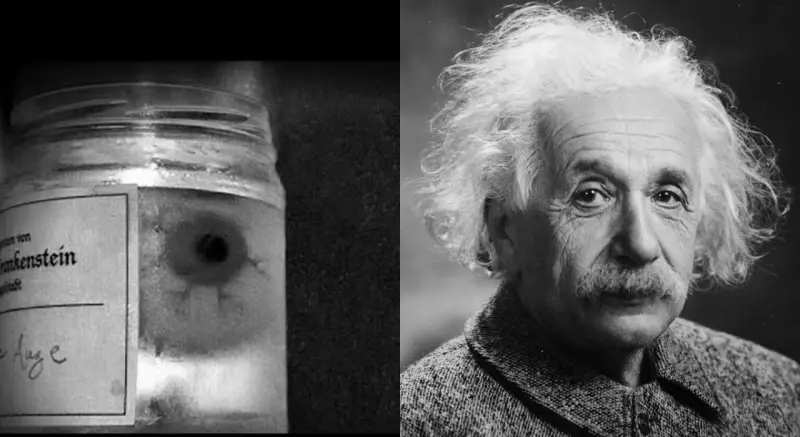
Even in death, the world's most celebrated genius could not escape becoming a spectacle. Albert Einstein, the father of modern physics, had one clear final wish: to be cremated and have his ashes scattered in secret. He explicitly wanted to avoid any shrines or relics. Yet, in the hours after he died, parts of his body were taken, launching a decades-long saga that directly contradicted his desires.
The Autopsy That Went Beyond Science
Einstein passed away in the early hours of April 18, 1955, at Princeton Hospital from a ruptured abdominal aortic aneurysm. He had refused surgery, famously stating he wished to go "when I want to go." The autopsy was performed by the hospital's chief pathologist, Dr. Thomas Stoltz Harvey. While Harvey's job was to determine the cause of death, he took it upon himself to remove and keep Einstein's brain. Less known, but equally significant, is that he also removed the physicist's eyeballs.
Harvey was a general pathologist, not a neurologist or brain specialist. His actions were not guided by a specific research protocol. Author Brian Burrell, in his book Postcards from the Brain Museum, suggests Harvey might have been inspired by studies on Lenin's brain or simply "got caught up in the moment." What is clear is that he acted without any immediate consent from Einstein or his family.

The Separate Fates of Brain and Eyes
The brain and the eyes then embarked on very different journeys. Days after the autopsy, Harvey sought retroactive approval from Einstein's eldest son, Hans Albert. Permission was given reluctantly, strictly for scientific study and publication. It notably did not cover the removal of the eyes.
Harvey was later dismissed from Princeton Hospital for refusing to hand over the brain. He sectioned it into roughly 240 pieces, preserved them in jars, and sent samples to researchers. For decades, the brain travelled with him, reportedly stored at times in a beer cooler.
The eyes, however, followed a quieter path. Harvey gave them to Einstein's longtime ophthalmologist, Dr. Henry Abrams. Unlike the brain, they were never studied, sectioned, or photographed. Abrams kept them privately, telling the Sun Sentinel in 1994 that having the eyes meant "the professor's life has not ended." He died in 2009 at age 97. The eyes are believed to remain in a safe deposit box in New York City, their existence confirmed only through second-hand reports, never displayed or returned to the family.
A Legacy of Contradiction and Possession
Ultimately, Einstein's instructions were only partially followed. His body was cremated and his ashes scattered. But key parts were preserved against his explicit wishes. No scientific study was ever conducted on his eyes; their value is purely symbolic, an object of possession.
This case highlights a profound ethical contradiction. A man who rejected physical veneration had his body parts institutionalised in private hands. The brain was at least framed as research, however unorthodox. The eyes were removed and hidden away with no clear purpose beyond possession, making their fate perhaps the most unsettling detail of all. Einstein's final wish for anonymity was overridden by a human desire to hold onto a piece of greatness, leaving a complex legacy far removed from the simple end he envisioned.