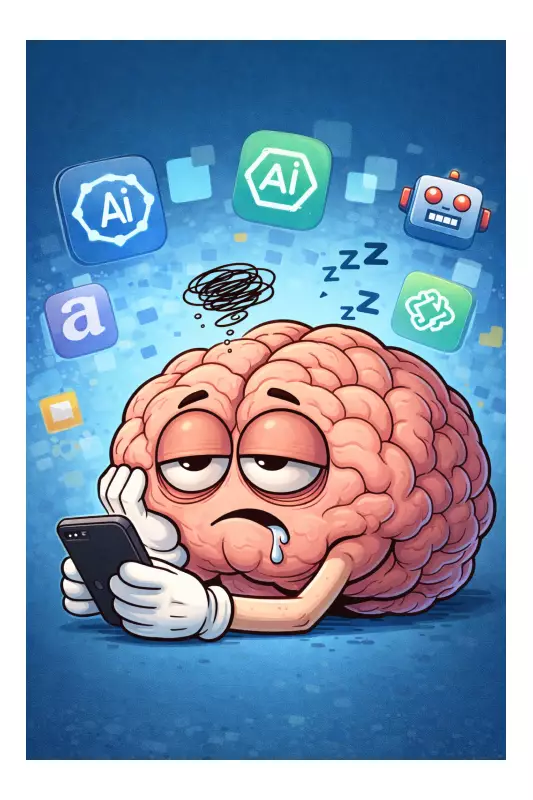
As 2025 draws to a close, a pervasive feeling of detachment and emptiness has settled over many. If you're experiencing this, mental health professionals point to a primary culprit: our increasingly AI-saturated digital lives. This isn't about apathy, but a fundamental neurological conflict triggered by how artificial intelligence engages—and disengages—our brains.
The Brain's Battle: Frontal Lobe vs. Daydreaming Network
Neuropsychiatrist Dr. E S Krishnamoorthy, founder of Chennai's Buddhi Clinic, explains this modern malaise as an imbalance. "The boredom many feel reflects a conflict between the frontal brain and the default mode network (DMN)," he states. The frontal lobe, responsible for focus and execution, is relentlessly over-stimulated by digital life, leading to poor attention and impulsive behavior akin to ADHD patterns.
In contrast, the DMN supports reflection and imagination. "In a healthy brain, they work in rhythm," says Dr. Krishnamoorthy. "But constant frontal activation suppresses the DMN, causing that 'busy yet unfulfilled' feeling." This explains why endless scrolling through 30-plus apps leaves you more bored than when you started—it's stimulation without true engagement.

The role of dopamine is also misunderstood. "It's the chemical of 'wanting,' not 'pleasure,'" he clarifies. "Endless wanting without fulfilment produces numbness. Technology suppresses the DMN passively through distraction, while intentional quieting leads to clarity."
The Death of 'Flow' and the Rise of Cognitive Offloading
Dilwar Hussain, Professor of Psychology at IIT Guwahati, analyses the issue through 'flow theory.' Flow is that optimal state of absorption where challenge meets skill, leading to enjoyment and peak performance. "Passive scrolling or delegating tasks like writing to LLMs requires little skill and offers no real challenge," Hussain notes. "It's stimulation without engagement. The under-challenged brain slides into boredom instead of flow."
This passive consumption erodes our attention span. When brains adapt to short, rapid content bursts, sustaining focus for longer durations—critical for learning and success—becomes harder. "AI use is not just a lifestyle concern but a cognitive one," Hussain warns.
He connects this to a worrying trend in IQ scores. After decades of increase (the Flynn effect), scores are now plateauing or declining in some nations. One explanation is 'cognitive offloading.' "As AI tools become more capable, our brains are asked to do less. We offload planning, remembering, and problem-solving. This leaves us less capable as our minds no longer work as hard," Hussain explains.
Research Evidence and the Path to Reengagement
Studies back these observations. Research on 'digital switching'—skipping between videos—shows higher switching correlates with lower satisfaction. Manoj Kumar Sharma, Professor of Clinical Psychology at NIMHANS's SHUT clinic in Bengaluru, cites an MIT study where participants using ChatGPT for creative writing showed the lowest brain activation in EEG scans and consistently underperformed, eventually resorting to copy-paste.
The demand for solutions is skyrocketing. NIMHANS's free digital detox program, which began with 100 participants six months ago, now draws over 5,000 registrations weekly. "More people feel disconnected from reality," Sharma observes.
The way forward, according to Dr. Krishnamoorthy, is to "protect attention as a biological resource." Sharma recommends deliberate reduction of screen time, replaced by socializing, exercise, or hobbies. Practical steps include taking a break after 20 minutes of screen use and practicing weekly 'digital fasts' with designated no-screen periods.
2025's Cultural Symbols of Detachment
The collective mood of the year was captured in three symbolic choices:
Emoji of the Year: The 'Face with Bags Under Eyes'—a symbol of disengagement.
Word of the Year: Dictionary.com's "six-seven," meaning so-so, ironically summing up the year.
Color of the Year: Pantone's white, named 'Cloud Dancer,' described as a shade that "encourages quiet focus for those seeking moments of disconnection."

The message from experts is clear: to make 2026 more engaging, we must consciously choose active immersion over passive AI-driven consumption.