

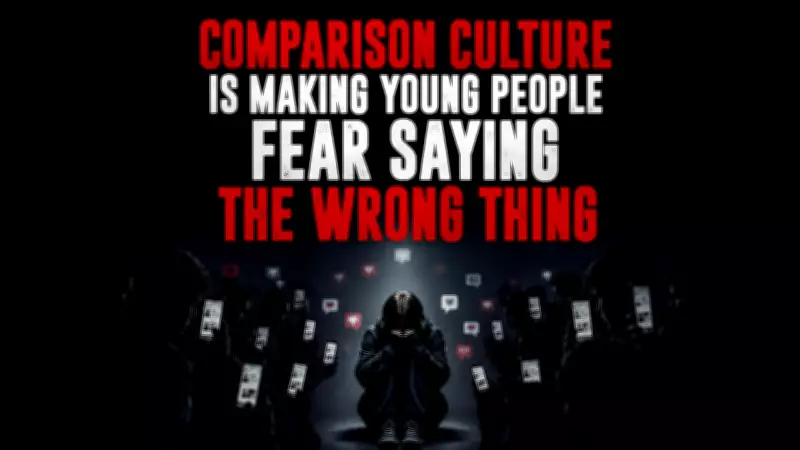
There's a particular kind of silence happening among young people right now. It's the silence of someone who has something to say but has quietly decided not to say it because they're already imagining how it might be received, dissected, and used against them.
An 18-year-old named William Marsden, featured in a December 2025 Index on Censorship report titled the Winter 2025 issue of Index on Censorship, Gen Z is revolting: Why the world’s youth will not be silenced, said he doesn't comment on TikTok or Instagram posts because people he knows will see it. "Certain things are funny," he said, "but some people might not think they're a joke and they might get the wrong idea." That's a teenager pre-editing himself before he's even typed anything. That's comparison culture working exactly as it does, making people measure every word against an imagined audience before they speak.
A Pew Research Center study conducted in late 2024, surveying around 1,400 US teens, found that 48% of them now believe social media has a mostly negative impact on people their age. So what's actually happening is a generation that's more connected than any before it, and simultaneously more afraid of being truly seen. Comparison culture didn't just make them feel inadequate. It made speaking up feel like a gamble not worth taking.

To discuss this we spoke to Praneet Mungali, educationist and Trustee at the Sanskriti Group of Schools. He spoke in depth about comparison culture, the growing pressure on young minds, and about a generation that now feels compelled to pre-edit its thoughts before speaking.
Can fear of saying the “wrong thing” affect a child’s confidence and social development over time?
Praneet Mungali: Yes when children constantly fear being judged for saying the wrong thing it can gradually lower their willingness to join conversations, ask questions or express themselves. Over time this may affect their self confidence, affect their relationships with others and hurt their ability to build healthy communication skills which are important for emotional and social growth.
Are children today becoming more socially anxious because of social media and constant online interaction?
Praneet Mungali: To a large extent yes social media has raised comparison culture. Children often feel pressure to look, act or speak in a certain way. Constant online interaction can reduce chances for natural face to face communication. This makes children more aware of how others see them and increases anxiety in social situations.
At what age do children start becoming self-conscious about what they say in conversations?
Praneet Mungali: Children usually start to develop self awareness between the ages of 6 and 8 but it becomes much stronger during pre adolescence and the teenage years from 10 to 15 years. At this time acceptance becomes very important. Children also become more aware of judgment, criticism, and the fear of embarrassment in conversations.
What are some healthy ways that can help children stop overthinking conversations and build emotional confidence?
Praneet Mungali: Creating a supportive environment at home and school is very important. Encouraging open communication allows children to express their opinions without fear of criticism. Reducing unhealthy screen time promoting group activities sports and teaching emotional resilience that can help children build confidence. Adults should focus on progress instead of perfection. They should help children understand that making mistakes while communicating is a normal part of learning and growth. Kids need to feel safe getting things wrong.
Not in theory but in practice, in real conversations, in the daily experience of saying something clumsy and having an adult respond with patience instead of correction. That's the thing comparison culture has quietly stolen from this generation.

And that's what makes this harder to fix than it looks. You can't just tell a 13-year-old to stop caring what people think. But you can build an environment around them where the cost of speaking up feels lower than the cost of staying silent. Where a wrong answer in class doesn't become a story that follows them. Where a clumsy comment at the dinner table doesn't get met with a look that says they should've known better.
The teenagers quietly pre-editing themselves before they type is pointing at the same thing. This generation isn't fragile. They're navigating something genuinely hard: a world that records everything, compares everything, and forgets almost nothing. The pressure that comes with that is real, and dismissing it doesn't make it smaller.
The question is whether the adults around them can make the path a little less lonely. Not by shielding young people from judgment entirely, but by showing them that saying the wrong thing is not the end of anything.
About the Author
Maitree Baral is a health journalist on a mission: making medical science digestible and healthcare approachable. Covering everything from wellness trends to life-changing medical research, she turns complex health topics into engaging, actionable stories readers can actually use.





