

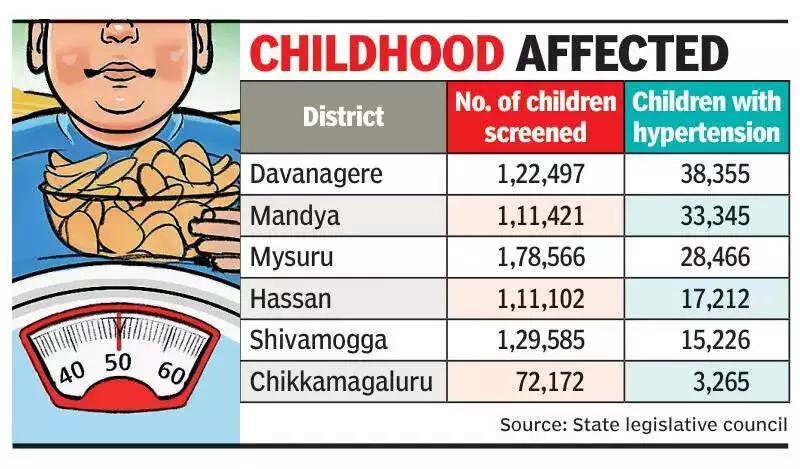
Alarming new health data from Karnataka has revealed a growing crisis of hypertension among school-going children, with Mandya district emerging as a major hotspot. According to official figures, nearly one in every three children screened in the district was found to have high blood pressure.
Disturbing District-Wide Health Screening Results
Health Minister Dinesh Gundurao shared concerning statistics in the Legislative Council during the Belagavi session, responding to a question from MLC Tippanna Kamaknoor. The data, collected under the RBSK Swasthya Kirana initiative between April 1 and November 30, 2025, shows a troubling picture.
In Mandya district, health workers screened 1,11,421 children from classes I to XII in government and aided schools. Among them, a staggering 33,345 children were diagnosed with hypertension. This translates to 29.9% of the screened student population.

This places Mandya as the district with the second highest prevalence of child hypertension in Karnataka. Only Davanagere district recorded a slightly higher percentage at 30.3%, where 38,355 out of 1,22,497 screened children were affected.
A Stark Contrast: The Best and Worst Performing Districts
The state-wide data paints a picture of significant disparity. While Mandya and Davanagere grapple with rates around 30%, other districts show remarkably lower figures.
Ramanagara district reported the lowest percentage in the state, with only 1.9% of children affected by hypertension. It was closely followed by Kodagu at 2.1% and Chamarajanagar at 2.4%.
Other districts from the data shared include:
- Mysuru: 28,466 cases out of 1,78,566 screened
- Hassan: 17,212 cases out of 1,11,102 screened
- Shivamogga: 15,226 cases out of 1,29,585 screened
- Chikkamagaluru: 3,265 cases out of 72,172 screened
Junk Food Addiction: Teachers Point to Dietary Causes
Educators in Mandya directly link this health epidemic to poor dietary habits. Despite the provision of healthy mid-day meals and eggs in schools, students are increasingly addicted to junk food available outside.
Shivanna Mangala, President of the High School Teachers' Association in Mandya, highlighted the severity of the issue. He revealed that students are spending an average of Rs 50 daily on unhealthy snacks and fast food. "Even after consuming healthy food provided at the school, they eat junk food. Naturally, it is affecting their health," he stated.
Mangala pointed to a critical lack of awareness among both parents and children regarding the dangerous long-term effects of such a diet. He also noted resistance from students when corrected. "If parents or teachers try to educate about the harmful effects of junk food, many students get angry. The public is not serious about the issue," he added.
Echoing this sentiment, an anonymous teacher called for immediate intervention. The teacher suggested that the health department must launch targeted awareness campaigns at the school level. "Doctors must create awareness as children listen to them," the teacher urged, emphasizing the need for authoritative health messaging.
The RBSK Swasthya Kirana data serves as a crucial wake-up call, indicating that lifestyle diseases are no longer confined to adults. The high prevalence of hypertension among children in districts like Mandya signals an urgent need for comprehensive strategies involving schools, parents, and health authorities to combat unhealthy eating habits and safeguard the future health of Karnataka's youth.






