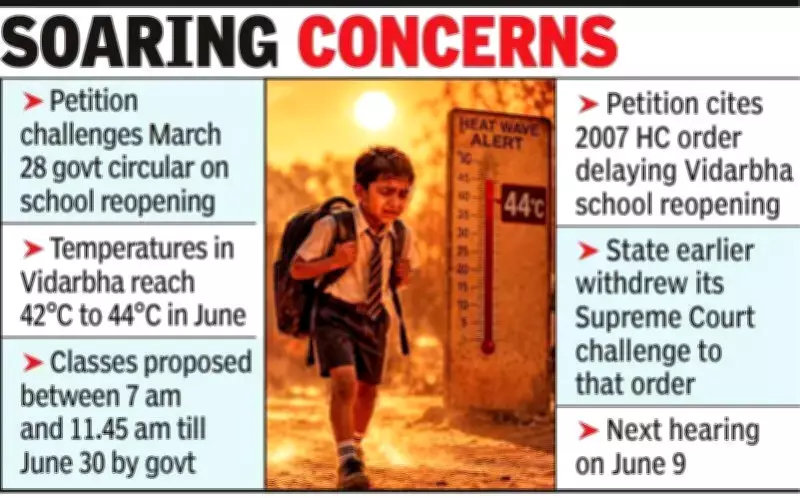
The Nagpur bench of the Bombay High Court on Tuesday questioned the Maharashtra government's decision to reopen schools in the Vidarbha region from June 15, despite soaring summer temperatures. The court asked why children should be compelled to attend classes in extreme heat conditions.
Court Proceedings
Acting on a petition challenging the state's March 28 circular, the summer vacation bench issued a notice to the government and directed it to file its response by June 9. The matter came up before Justice Rajnish Vyas after a plea was filed by Vijay Kombe, president of the Wardha unit of the Maharashtra State Primary Education Committee, Pune, along with Liladhar Thakre.
Petitioners' Arguments
The petition, filed through counsel Bhanudas Kulkarni, argues that the government's decision to start the academic session from June 15 across Maharashtra ignores Vidarbha's severe climatic conditions, where temperatures in June hover around 42°C to 44°C. Under the circular, schools have been directed to conduct classes between 7 am and 11:45 am from June 15 to June 30.

The petitioners contended that the schedule could endanger students, particularly in rural areas where many children walk 3 to 5 kilometers daily to reach school. While students may travel in comparatively cooler hours in the morning, returning home under harsh afternoon heat could adversely affect their health, they argued.
Previous Court Order
During the hearing, the petitioners also cited a 2007 order of the High Court's Nagpur bench that directed schools in Vidarbha to reopen only after June 30 in view of the region's intense summer conditions. Although the state challenged that ruling before the Supreme Court through a special leave petition, it was later withdrawn.
The plea further noted that subsequent government resolutions issued on June 22, 2007, April 11, 2022, and April 20, 2023 had continued the policy of reopening Vidarbha schools after June 30. The petitioners argued that the education department could not unilaterally alter an established policy framework through a fresh circular.
Broader Implications
The case has revived a recurring debate in Maharashtra over whether a uniform academic calendar can adequately address the vastly different climatic realities across regions, particularly in Vidarbha, where prolonged heat waves have increasingly become a public health concern.