

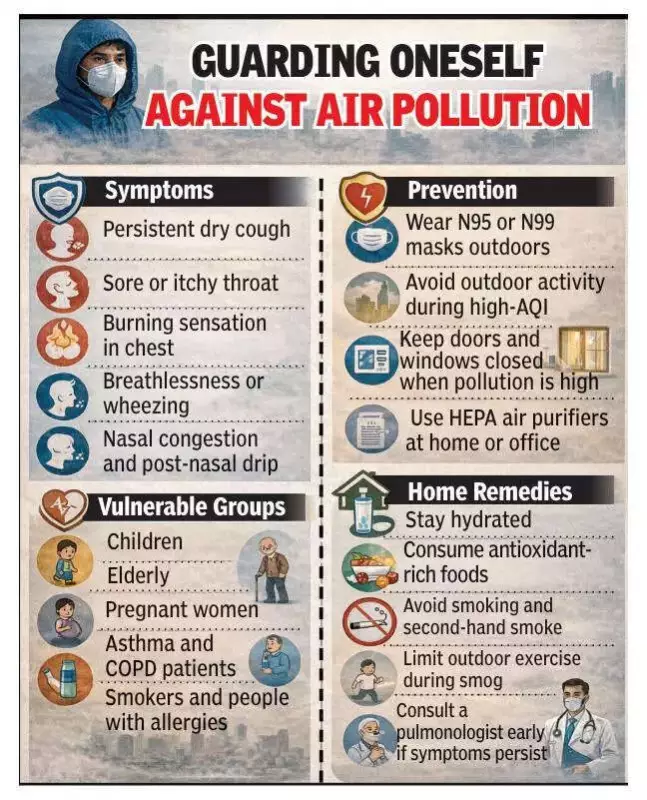
Residents of Lucknow experiencing a nagging dry cough, sore throat, or a burning sensation in the chest are being urged to look beyond the usual suspect of seasonal flu. Medical experts in the city have issued a stark warning, directly linking these symptoms to the deteriorating air quality rather than viral infections.
Hospitals Overwhelmed by Respiratory Distress
A clear and alarming trend is emerging across Lucknow's major hospitals, indicating a public health crisis driven by pollution. The King George's Medical University (KGMU) and Dr. Ram Manohar Lohia Institute of Medical Sciences (RMLIMS) are now seeing between 100 to 125 patients daily with pollution-related respiratory issues. This marks a staggering increase from just 30 to 40 cases reported two months ago, representing a surge of over 300%.
The situation is equally grim at private facilities. Medanta Hospital has witnessed its daily count of pollution-linked respiratory cases jump from 2-3 to 14-18 over the past four months. Similarly, Max Super Speciality Hospital and Apollo Medics have recorded a 40-50% overall rise in respiratory OPD cases, with doctors noting that patient numbers almost double on days when the Air Quality Index (AQI) is particularly high.

Why Pollution Mimics Flu and Attacks the Lungs
Doctors explain that pollutants act as direct irritants to the respiratory system. Dr. Abhishek Tandon, Associate Consultant in Respiratory and Sleep Medicine at Medanta Hospital, detailed the mechanism. He stated that gases like sulphur dioxide, nitrogen dioxide, and ozone—primarily emitted from vehicles—aggressively irritate the airways, triggering flu-like symptoms even in otherwise healthy individuals.
"These pollutants make the lining of the airway hypersensitive, leading to nasal discharge that flows into the throat. This causes persistent irritation and that characteristic dry cough," Dr. Tandon explained. He emphasized that since these symptoms occur without fever, many people mistake them for a mild flu and delay seeking proper treatment, exacerbating the problem.
Dr. Shubham Agarwal, Consultant at Apollo Medics Hospital, highlighted the danger of particulate matter. He pointed out that fine particles like PM2.5 and PM10 settle deep into the lungs, causing long-term damage and triggering severe asthma attacks, a phenomenon now increasingly observed among young people.
High-Risk Groups and Critical Prevention Steps
The warnings are especially dire for vulnerable populations. Children, the elderly, and those with pre-existing conditions like asthma and Chronic Obstructive Pulmonary Disease (COPD) are at significantly higher risk.
Dr. Rajneesh Kumar Srivastava of Max Super Speciality Hospital elaborated, "Children's lungs are still developing, they breathe faster, and they spend more time outdoors, which dramatically increases their exposure to harmful substances like PM2.5, SO₂, and NO₂. In older adults, naturally weaker lungs and reduced immunity mean conditions like COPD and asthma can worsen much more easily."
Prof. Ajay Kumar Verma, Head of Respiratory Medicine at RMLIMS, provided a simple yet effective solution based on recent experience. "Wearing masks, as we did during the Covid-19 period, especially during morning and evening hours when pollution peaks, can significantly help avoid such symptoms," he advised. Echoing this, Dr. Tandon stressed that prevention is critical, urging even patients on regular medication to wear N95 masks outdoors, as unprotected exposure can swiftly reverse recovery.
The collective medical advice is unequivocal: long-term exposure to Lucknow's polluted air is a direct pathway to serious diseases, including asthma, COPD, other lung diseases, and cardiovascular problems. The current spike in hospital admissions serves as a urgent call for both personal precaution and broader environmental action.






