

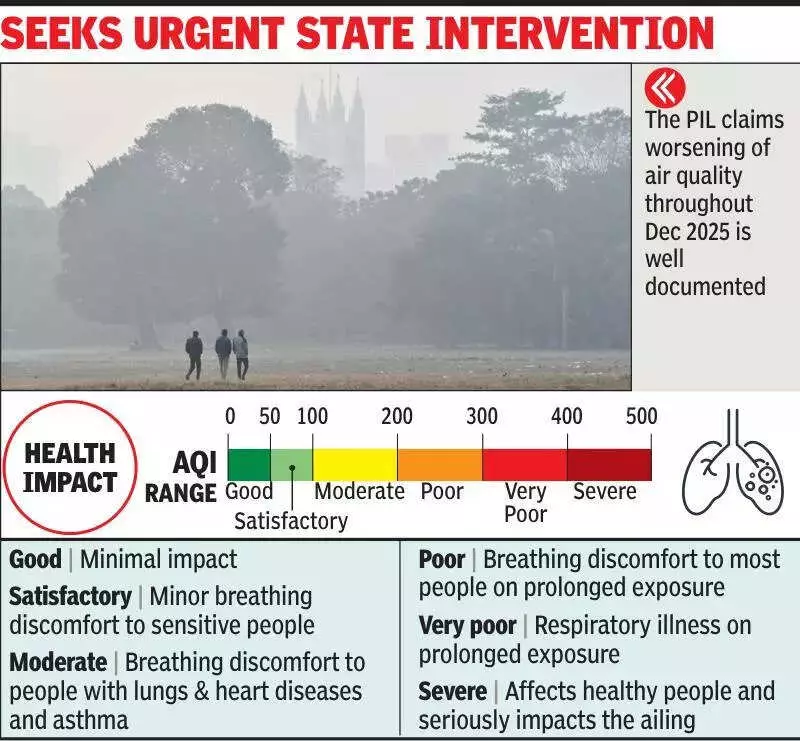
A significant public interest litigation (PIL) has been placed before the Calcutta High Court, urging the judiciary to officially declare the persistently 'very poor' air quality in the Kolkata-Howrah metropolitan region a 'public health emergency'. The petition is scheduled for a hearing on January 19.
Petition Details and State's Response
The PIL was filed by practicing advocate Akash Sharma before a division bench led by Acting Chief Justice Sujoy Paul. It underscores the severe and recurring decline in air quality, demanding urgent and enforceable intervention from the West Bengal government.
Sharma had previously submitted a detailed representation on November 12, 2025, to the state's chief secretary, the chairman of the West Bengal Pollution Control Board (WBPCB), and the principal secretary of environment. This document warned of predictable winter pollution and specifically requested the formulation of a structured Graded Response Action Plan (GRAP).

In reply, the WBPCB sent an email on November 18, 2025, stating it was 'undergoing research and preliminary testing for implementing a software-based GRAP'. The PIL argues that this response failed to commit to any time-bound or legally enforceable measures to tackle the imminent crisis.
Escalating Health Crisis and Demands
The petition contends that the well-documented deterioration of air quality throughout December 2025 proved the initial warnings were accurate and that authorities had taken no concrete action. It cites medical reports from mid-December noting a steady increase in hospital outpatient visits for respiratory illnesses.
Pulmonologists from leading Kolkata hospitals warned that PM 2.5 and PM 10 particles were deeply infiltrating lung alveoli, leading to carbon deposition, chronic inflammation, reduced lung capacity, and early signs of a condition termed 'urban lung'.
The PIL seeks several specific directives from the court, including:
- Official notification of a GRAP for Kolkata-Howrah.
- Creation of an expert airshed task force.
- A strict ban on open waste burning, with municipal accountability.
- Comprehensive industrial pollution audits and continuous emission monitoring.
- Time-bound control of vehicular emissions, including phased scrapping of high-emission vehicles.
- Regulation of inter-state diesel buses.
- Binding public health advisories for high-AQI days with mandatory precautions for schools and hospitals.
Constitutional Right to Clean Air
Clarifying its intent, the petition states it does not seek to substitute policy-making. Instead, it requests limited judicial directions to ensure the effective enforcement of existing environmental laws. The plea is grounded in the protection of the fundamental right to clean air under Article 21 (Protection of Life and Personal Liberty) and Article 47 of the Indian Constitution, which mandates the state to improve public health and living standards.
The upcoming court hearing on January 19 is now a focal point for environmental and public health advocates in the city, awaiting judicial guidance on this pressing issue.






