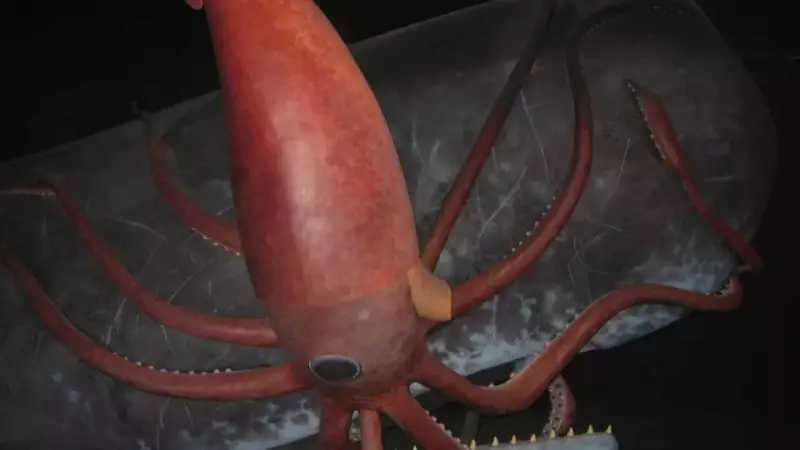
Imagine gazing into the abyssal darkness of the Southern Ocean and encountering a pair of eyes as large as soccer balls staring back at you. This is the reality for the colossal squid, a deep-sea dweller whose extraordinary vision is a testament to evolutionary adaptation in one of Earth's most extreme environments.
The Largest Eyes in the Animal Kingdom
Scientific measurements reveal that adult colossal squids possess eyes with a diameter of nearly 11 inches, equivalent to 27-30 centimeters. This remarkable size makes them the largest eyes of any living creature on our planet, far surpassing those of other marine giants.
Comparative Eye Sizes in Marine Life
When researchers examined specimens of Mesonychoteuthis hamiltoni, they documented eyes reaching up to 30 centimeters in diameter. To put this in perspective:

- Giant squid eyes are significantly smaller
- Large fish like swordfish have eyes measuring only about 9 centimeters
- Even whales and other vertebrates of comparable size have much smaller visual organs
Survival in the Lightless Depths
The colossal squid inhabits regions thousands of feet below the ocean surface, where sunlight barely penetrates. In this perpetual darkness, their massive eyes serve as crucial survival tools rather than mere biological curiosities.
Detecting Predators Through Bioluminescence
A groundbreaking study published in Current Biology explains that these enormous eyes are specially adapted to detect large predators, particularly sperm whales. As these whales swim through the deep sea, they disturb bioluminescent organisms, creating faint light flashes against the darkness.
The colossal squid's large pupils can gather these minimal light signals from distances exceeding 120 meters, providing precious seconds to evade approaching threats. In the deep ocean, where vision literally means the difference between life and death, larger eyes translate to better detection capabilities.
How Giant Eyes Enhance Deep-Sea Vision
In environments with virtually no downwelling light, bioluminescence becomes the primary light source. The colossal squid's enormous eyes function through several key mechanisms:
- Photon Collection: Large pupils capture more light particles than smaller eyes
- Signal Detection: Enhanced ability to perceive shapes, movement, and contrast in low-light conditions
- Light Scattering Reduction: Minimizes distortion of faint luminescent signals
Evolutionary Advantages
While most surface-dwelling animals don't require such large eyes due to abundant light, the colossal squid's deep-sea existence demanded different adaptations. Over millions of years, natural selection favored individuals with larger eyes that could better interpret the subtle light signals of their dark world.
This evolutionary pressure resulted in the development of visual organs that maximize the chances of detecting both predators and potential prey in an environment where every photon counts.
The colossal squid's remarkable eyes represent one of nature's most fascinating adaptations to extreme environments, demonstrating how life evolves extraordinary solutions to survive in Earth's most challenging habitats.