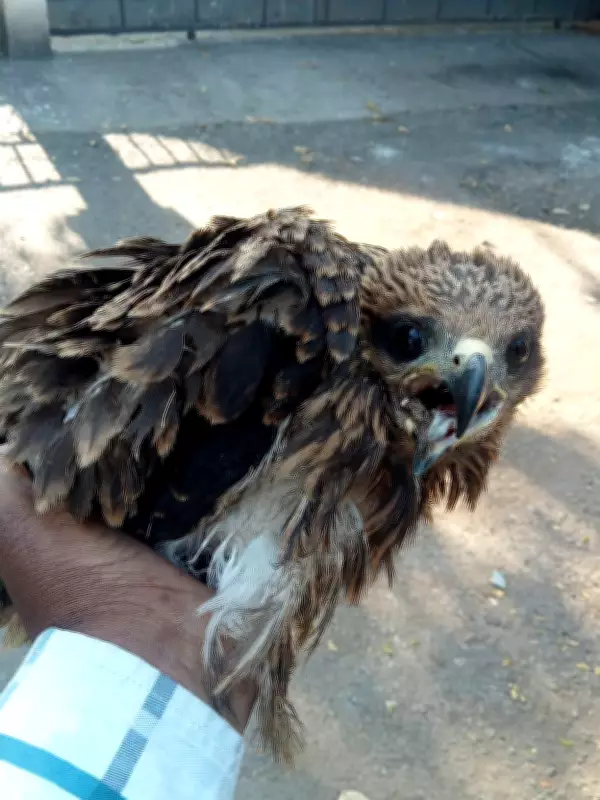
Pune: As an intense heatwave stretches into June, wildlife rescuers are reporting a record number of bird rescues across the city and surrounding districts. Black kites and eagles have been the hardest hit, with rescuers attending to at least seven to eight cases of dehydrated, exhausted, or heat-stressed birds every day, a sharp increase compared to previous years.
Many of these birds are found in a state of collapse near drying water sources or in open grounds, too weak to fly. “I have never seen so many rescues in June. This month alone, I have rescued 25 eagles,” said Anil Avachite, a local bird rescuer. “These birds fly higher than most others, making them particularly susceptible to heatstroke in these soaring temperatures.”
The prolonged summer and the depletion of natural water sources have placed immense stress on urban bird populations. Residents have become the first line of defence. Nagesh Kulkarni, a resident of Baner, recently spotted a weak eagle during his morning walk on Baner Hill. “I saw it lying on the side of the road, weakly fluttering its wings. It was clearly dehydrated, so I immediately contacted a local rescuer to help revive it,” he said.

Pawan Sharma, wildlife conservationist and founder-president, Resqink Association for Wildlife Welfare, noted that the scale is staggering. “The total number of birds rescued across the Mumbai Metropolitan Region (MMR) since March has exceeded 600. This excludes mammals and reptiles. While dehydration is the primary cause, many cases are exacerbated by starvation, disorientation, and poor air quality (AQI),” Sharma said. Among the notable rescues was a Shaheen Falcon, one of the world’s fastest birds of prey.
The danger to these birds isn’t just the heat, but also the vulnerability that comes with it. Nishi Mehta, a resident of Hadapsar, recently intervened when she saw a helpless kite on the roadside. “It looked famished and disoriented. Some stray dogs were trying to attack it, so I chased them away and waited until the rescue team arrived,” she recounted.
Rescue calls typically peak during the afternoon and early evening when the heat is most punishing. Areas such as Baner, Hinjewadi, Hadapsar, and Kharadi have emerged as hotspots for these calls.
“The recovery process is delicate,” said a rescue volunteer. “We first place the bird in a controlled, safe environment—like a quiet room or a specialised cage—and begin the rehydration process. Once the bird has regained its strength and is stabilized, it is released back into the wild.”
The trend is mirrored in the Pimpri-Chinchwad (PCMC) area as well. Shubham Pande, who runs the NGO World For Nature, has been working around the clock. “We are receiving a high volume of calls for kites and kingfishers. A vast majority of these birds are suffering from severe dehydration,” Pande said.
Stay updated with the latest Pune news. Download the TOI App.