Saurashtra University Study Exposes Alarming Driving Mindset in Rajkot
A comprehensive psychological survey conducted by Saurashtra University has uncovered troubling insights into driving behavior, suggesting that traffic problems in the region stem more from mindset than infrastructure deficiencies. Based on responses from 1,456 participants in Rajkot, the study reveals a deep-seated cultural acceptance of rule-breaking on the roads.
Swag Over Safety: A Distorted Social Perception
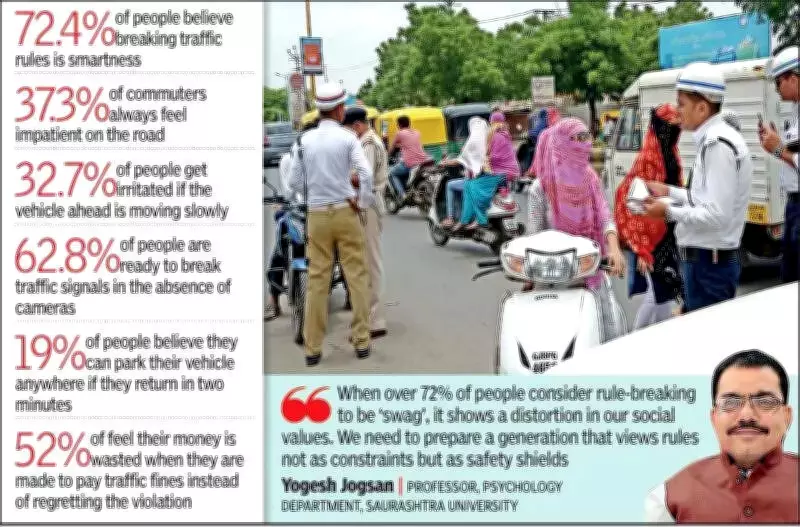
The most alarming finding is a widespread social distortion where traffic violations are viewed as indicators of 'smartness' or 'swag'. As many as 72.4% of respondents agreed that breaking traffic rules has become a sign of social status, reflecting a dangerous normalization of risky behavior. This perception, according to researchers, points to a severe lack of self-control and a worrying embrace of rule-breaking as a form of identity expression.
Anger and Impatience Fueling Road Accidents
The survey highlights high levels of emotional instability among drivers, with 37.3% admitting to feeling impatient while driving and 32.7% reporting immediate anger if the vehicle ahead is slightly slow. Professor Dhara R Doshi, who guided the study alongside Professor Yogesh Jogasan, emphasized that such impatience lies at the root of road rage and hazardous driving. Additionally, 33.7% of drivers indulge in competitive overtaking, revealing a disturbing ego-driven mindset that prioritizes personal gain over collective safety.

External Fear Over Internal Discipline
A stark lack of internal discipline among commuters is evident, as 62.8% of respondents said they would consider breaking a traffic signal if they knew there were no cameras on the road. This indicates that compliance is driven by fear of external threats like police checks and surveillance, rather than self-discipline or genuine concern for safety. The study underscores that reliance on punitive measures alone is insufficient to foster responsible driving habits.
Social Arrogance and the 'Arrogance of Power'
The survey also highlighted social arrogance on the roads, with 60% of respondents believing that drivers of big or expensive vehicles give less importance to those on smaller vehicles. Researchers termed this phenomenon the 'arrogance of power', where social status is projected onto road behavior, exacerbating conflicts and unsafe conditions. This attitude contributes to a hierarchical mindset that undermines mutual respect and safety.
Call for Change in Mentality and Proposed Solutions
When asked about solutions for road discipline, 68.4% of participants favored a change in people's mentality, while only 31.6% supported stricter laws. The researchers proposed psychological interventions, such as sensitivity training before issuing driver's licenses and integrating traffic discipline into school curricula as part of cultural and citizenship education. They argue that fines and cameras alone cannot resolve India's traffic chaos; a fundamental shift in attitudes is essential.
The report concludes with a powerful message: 'This survey proves that if we bring a slight change in our mentality and maintain patience, 90% of road accidents and traffic jam problems can be avoided. Driving is not just a mechanical process but a reflection of your civility and culture.' The study was conducted by psychology department students, including Jaya Jamod, Smit Ramani, Gautam Lagariya, and Divya Jambusa, who collected data from drivers across Rajkot to provide these critical insights.