Wellness Music Emerges as Fastest-Growing Trend in Music Industry
As the world marks World Music Day on Sunday, relaxing sounds are emerging as one of music’s fastest-growing trends, driven by a broader wellness boom. According to the Global Wellness Institute, the global wellness economy reached $6.8 trillion in 2024 and is projected to grow to $9.8 trillion by 2029. This shift is bringing Indian classical ragas, mantras, and devotional music to new audiences worldwide.
Indian Traditions at the Forefront of Wellness Listening
American pianist Chad Lawson, who collaborated with Indian musicians Rasika Shekar, Purbayan Chatterjee, Nush Lewis, and Paayal Lal on his album Awakening: The Stillness Within, noted that music and spirituality are naturally woven into daily life in India. “When I was in India, what I kept hearing were stories about how music lived in people’s homes growing up. A mantra in the early morning, a bhajan drifting in from the kitchen, a grandparent humming something they’d learned from their own grandparent. Wellness music has always been part of their culture,” Lawson said.
Charu Suri, a Grammy-nominated New York-based pianist, composer, and bandleader known for presenting ragas through jazz ensembles and symphony orchestras, highlighted both opportunities and challenges. “Such crossover formats help bring Indian classical music to new audiences. Indian classical melody and ragas presented in a modern format have helped people discover the music characteristics of helping our well-being,” she said. However, she warned that music increasingly becomes background sound. “Many people spin jazz or classical music while doing household chores because our time is precious and limited. But that further fractures our focus and ability to show sustained concentration on the piece of music we are listening to, which doesn’t allow you to connect with the sound.”

India’s Deep Relationship with Sound Creates Global Opportunities
Faustin Missier, Business Head at Vedam Records, believes India has the foundations to become a global leader in wellness music. “India has always had a deep relationship with sound. Whether it is mantra, raga, chanting, devotional music, temple traditions, sound bowls or meditative practices, sound has always been part of how we pray, reflect, gather, regulate and return to ourselves,” he said.
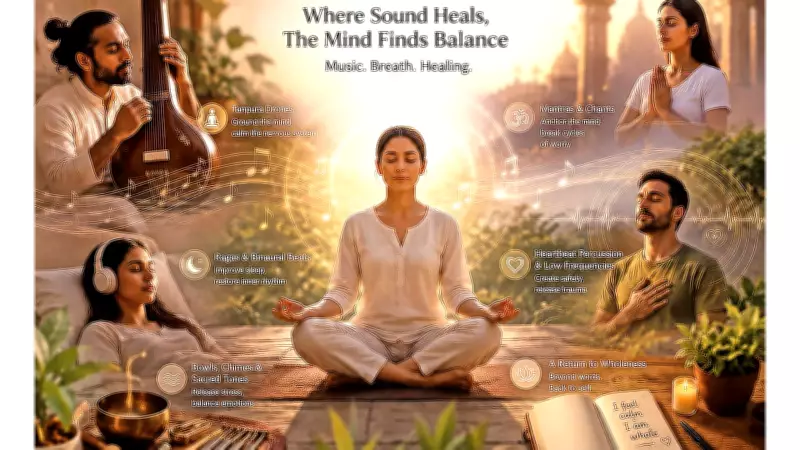
Akash, a certified pranic and spiritual healer, explained the physiological impact. “Using sustained tones—tanpura drones, morning ragas like Bhairav, simple Sanskrit mantras, and slow breath-synced bowls and chimes—we help the nervous system reorganize: breathing slows, the fight-or-flight alarm eases, and the mind steadies. For anxiety and panic, repeated sacred sounds anchor attention and interrupt worry spirals; for insomnia, gentle drones and sleep ragas shift brainwaves toward rest; for trauma survivors, heartbeat-like percussion, low frequencies, and vocal toning create a contained, safe space where emotions can be felt and released, helping restore wholeness that words alone often can’t reach.”
Ancient Traditions Contemporised for Modern Audiences
Rapper and Bharatanatyam dancer Raja Kumari, whose recent work including Kashi to Kailash explores Sanskrit mantras and spiritual traditions, said, “My journey in wellness music started with simply changing background vocals that would say ‘oh’ into ‘Aum’. Repetition and sacred sound are among the most important things of wellness music that we, as musicians, can learn to apply to our music as we move from the ancient into the future. I truly believe this powerful sonic tradition has healing properties that have been part of our ancient culture for a long time, and now it has just been contemporised into wellness music.”

Siddhant Bhatia, Grammy-nominated musician who worked on Sounds of Kumbha, emphasized that Indian music was never meant for entertainment alone. “Our ragas, mantras, folk traditions and sacred chants were designed to influence consciousness, emotion and wellbeing long before the term ‘wellness music’ existed. A morning raga, a simple mantra, the sound of a bansuri, a tanpura drone, or even traditional temple bells can create a sense of grounding that transcends language and culture,” he said. For Bhatia, concepts like Nada Brahma—the idea that the universe itself is sound—have existed in India for centuries.
Listeners Find Solace in Wellness Music
Listeners report significant benefits. Arya Roy, 25, a marketing professional, said, “For years I struggled with sleep, but music changed that. I listen to a Yoga Nidra guided playlist for about an hour before bed and it helps me escape negative thoughts and sleep.” Deeksha Sawlani, 30, used music to ease pandemic anxiety: “I tried Om chants and they calm my mind—sometimes the sound keeps playing in my head and I drift off. Mellow Sufi tracks also break anxious cycles and steady my breathing. I even use soothing music during yoga warm-ups to relax.”
Yoga therapist Jigyasa Panjwani added, “I use music to clear mental clutter and make yoga a safe, slower space. Raga Reethigowla brings a calm like the stillness after a storm. In India, sound, from temple chants to birdsong, has long aided well-being. Today we recreate that calm with music, and binaural beats can help shift brainwaves for deeper sleep.”