Viral 1897 Royal Menu Uncovers Indian Maharajas' French Culinary Preferences
History often reveals its most intriguing secrets through the most unexpected artifacts. A remarkable discovery circulating on social media has captured global attention: a meticulously preserved dinner menu from the year 1897, detailing the elaborate feast hosted by the Maharaja of Baroda for the Maharaja of Gwalior. This extraordinary document provides a rare window into the sophisticated dining customs of Indian royalty during the late Victorian era, blending traditional Indian hospitality with European culinary elegance in ways that continue to astonish modern observers.
Archival Discovery by Food Historian Neha Vermani
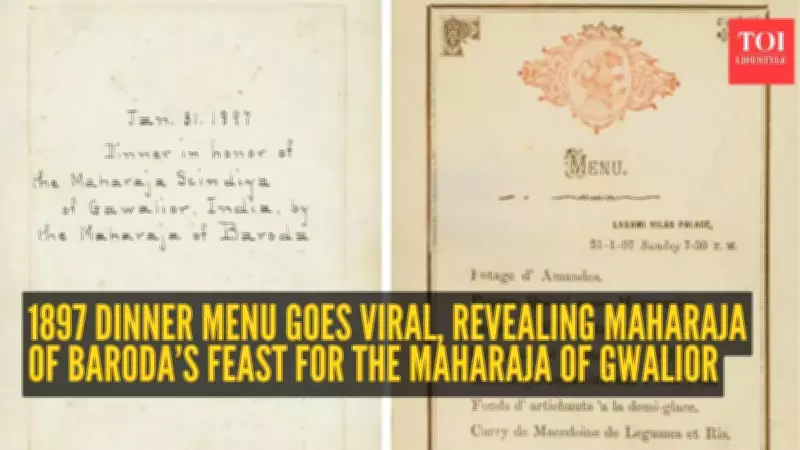
Historian Neha Vermani, whose academic focus encompasses Mughal South Asia and culinary history, brought this fascinating artifact to public attention through her social media channels. During her extensive archival research, Vermani encountered this remarkable menu dated January 31, 1897, documenting a formal state dinner held at the magnificent Laxmi Vilas Palace in Gujarat. The menu represents not merely a list of dishes but a cultural statement about how Indian royalty presented themselves to distinguished guests during this historical period.
Unexpected French Culinary Dominance in Indian Palace Setting
The menu's most striking feature is its overwhelming French character, with nearly all dishes presented in French language and prepared according to European culinary traditions. Vermani captured this surprising revelation perfectly in her commentary, noting: "Not what you'd expect a 19th-century dinner hosted by the Maharaja of Baroda for the Maharaja of Gwalior to look or taste like, featuring truffles, artichokes, and way too many fancy French names & stuff." This demonstrates that Indian royalty were not merely aware of European cuisine but actively embraced and showcased it as a symbol of cosmopolitan sophistication and status.

Detailed Analysis of the 1897 Royal Banquet Courses
The elaborate multi-course dinner began with Iotage d'Amandes, a delicate almond custard or flan likely served as an elegant starter. This was followed by Poisson braisé sauce mayonnaise, featuring braised fish accompanied by a rich, creamy mayonnaise sauce. One of the most luxurious offerings was Crème de Volaille truffée, a sumptuous creamy chicken soup enhanced with prized truffles.
For the main courses, guests enjoyed Côtelettes de mouton à l'Italienne – lamb cutlets prepared in Italian style with aromatic herbs. Another highlight was Selle de perdreau rôtie aux petits pois, presenting a perfectly roasted saddle of partridge served alongside fresh green peas. The vegetable course featured Fonds d'artichauts à la demi-glace, consisting of artichoke bottoms cooked in a rich brown demi-glace sauce.
A notable Indian element appeared as Curry de Macédoine de légumes et riz, a vegetable and rice curry that provided familiar flavors amidst the European dishes. The dessert course concluded the meal with Pommes à la crème (apples cooked in cream) and Glace de Pistachio (pistachio ice cream), offering a sweet finale to this extraordinary culinary experience.
Social Media Reactions and Historical Reflections
The viral menu sparked diverse reactions across social media platforms. One insightful observer commented: "After visiting the Palazzo Pitti in Florence, I realized that Indian princes lived like Western aristocrats. Because it reminded me of the palaces I had grown up visiting in Rajasthan. Also BTW, a couple of those items are Indian items described in French." Another user reflected on the strategic purpose behind such elaborate banquets: "The chief purpose of such banquets was/is to dazzle and overwhelm."
Some reactions were more concise, with one user simply noting "Very swadeshi," while others expressed temporal astonishment: "31-1-97 always meant 1997 for me. 1897 is beyond my imagination." The overall sentiment was captured by another user who called it an "interesting find" that bridges historical and contemporary curiosity about royal lifestyles.

Historical Significance and Cultural Implications
According to Vermani's research, the original menu is now preserved in an archival collection in the United States. Beyond its culinary details, this document serves as important historical evidence of how Indian elites during the colonial period strategically blended local traditions with global influences. The menu demonstrates that food served multiple purposes in royal contexts – not merely nourishment but also as expressions of style, status, and sophisticated cultural awareness.
More than 125 years after this dinner occurred, this seemingly simple menu continues to generate fascination and discussion. It reminds us that historical understanding can emerge from the most ordinary artifacts, and that culinary choices often reflect broader cultural negotiations and identity expressions. The 1897 menu stands as a vivid testament to the complex cultural exchanges that characterized India's royal households during this transformative historical period.