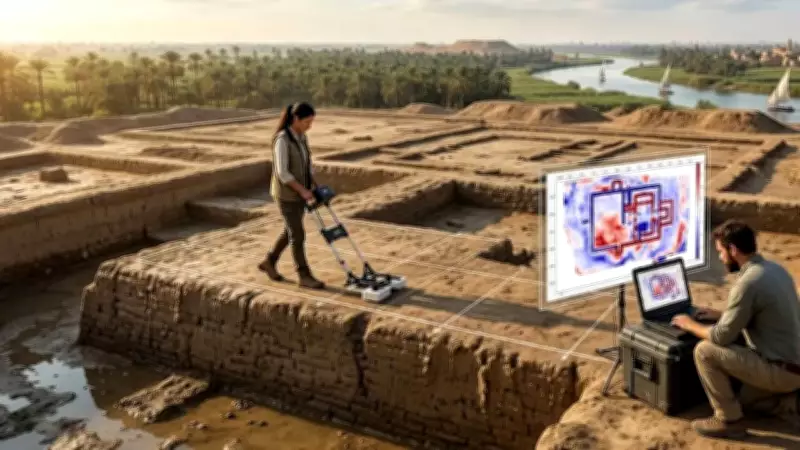
Egyptian Delta Reveals 2,500-Year-Old Mud-Brick Building via Geophysical Survey
Archaeologists have made a groundbreaking discovery in Egypt's Nile Delta, unearthing a massive mud-brick building that dates back 2,500 years. This ancient structure, buried for millennia under silty deposits and waterlogged sediments, was located using advanced non-invasive geophysical techniques, including magnetometry and electrical resistivity tomography.
Discovery at Tell el-Balamun
The building was identified as part of a recent archaeological project at Tell el-Balamun, conducted by researchers from the Polish Centre of Mediterranean Archaeology in collaboration with local authorities. It originates from the Late Period of Ancient Egyptian history, specifically the 26th Dynasty, also known as the Saite Period.
This find holds immense archaeological significance because the Delta region's exceptionally high water table typically destroys most ancient materials. The preservation of this large, hidden monumental building provides an unprecedented in situ record of urban planning and administrative arrangements during a crucial era in Mediterranean and Egyptian history.

Non-Invasive Mapping Techniques
Using non-destructive geophysical survey methods, the team generated a high-resolution plot of the site's footprint without intrusive excavation. By detecting magnetic anomalies and measuring electrical resistance in the silt-laden soil, they mapped the mud-brick walls, revealing the extensive layout of this ancient complex.
According to research published by the British Museum, well-preserved mud-brick structures are rare in the Nile Delta due to the wet environment and natural water table. Most materials from this area deteriorate or compress over time, making this discovery a scientific treasure—a time capsule offering insights into architectural techniques of the Late Period.
Administrative Hub of the Saite Dynasty
Tell el-Balamun was constructed approximately 2,500 years ago during a period of cultural and political renewal in Egypt. It served as a strategic northern frontier outpost, functioning as a key administrative and religious centre. The large size of the complex suggests it may have been an elite residence or government headquarters, reflecting the centralisation and organisation of the Delta population at that time.
Mapping these submerged foundations allows researchers to reconstruct the lost geopolitical landscape of the Saite Dynasty's northern administrative hubs, shedding light on power dynamics and regional significance.
Engineering Marvel Against Floodwaters
The construction of this large structure exemplifies how ancient Egyptians built cities on marshy terrain. The thickness of the mud-brick walls indicates that engineers possessed advanced knowledge to withstand the Nile's annual floodwaters. Analysis of the overall layout will help historians understand power transfers and the Delta's role as a strategic location for Mediterranean trade and defence against military attacks.
As noted by the UNESCO World Heritage Centre, this discovery serves as a model for ancient urban resilience, highlighting the ingenuity of Egyptian civilisation in adapting to challenging environments.