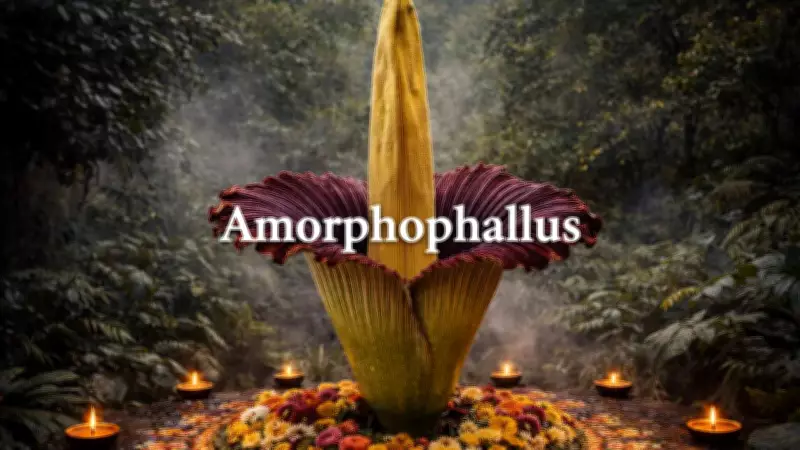
The Amorphophallus: Nature's Most Bizarre and Foul-Smelling Marvel
In the vast and diverse world of flora, where beauty often takes center stage, some plants captivate attention not for their aesthetic appeal but for their sheer uniqueness. Among these botanical oddities stands the Amorphophallus, a genus of tropical plants that defies conventional expectations with its extraordinary characteristics.
A Flower That Embraces the Macabre
Imagine an enormous flower that remains closed for most of its life, only to unveil itself on rare occasions. When it does bloom, it reaches impressive heights and releases a pungent odor that many describe as reminiscent of decayed meat or rotting flesh. This foul scent, far from repelling observers, often draws massive crowds and scientific interest, making the Amorphophallus a celebrated spectacle in the plant kingdom.
Understanding the Amorphophallus Genus
The term Amorphophallus originates from Greek roots: amorphos, meaning "without form or irregular," and phallos, translating to "rod" or "shaft." This name aptly reflects the plant's distinct and often irregular physical structure, setting it apart from more common flowering species. The genus thrives in tropical climates, where its members exhibit a combination of striking appearances and powerful aromas.

One of the most renowned species within this genus is the so-called "corpse flower," scientifically known as Amorphophallus titanum or titan arum. It has gained global fame for its sporadic blooming events, during which it emits a scent likened to decomposing organic matter. This odor serves a biological purpose, attracting pollinators such as carrion beetles and flies that are typically drawn to decaying substances.
Pronunciation and Usage in Language
The correct pronunciation of Amorphophallus is uh-MOR-foh-FAL-us, with phonetic spelling represented as /əˌmɔːr.foʊˈfæl.əs/. The stress falls on the fourth syllable, "FAL." In everyday language, it can be used in sentences like: "The botanical garden announced the blooming of the Amorphophallus, attracting visitors from afar," or "Scientists study Amorphophallus plants for their unique pollination mechanisms."
Synonyms and Antonyms
Synonyms for Amorphophallus include corpse flower, titan arum, tropical flowering plant, and exotic plant. In contrast, antonyms encompass common plant, ordinary flower, fragrant flower, and garden variety plant, highlighting its exceptional nature compared to more conventional flora.
Scientific and Cultural Significance
Beyond its notorious smell, the Amorphophallus holds significant value in botanical research. Its rare blooming patterns and specialized pollination strategies intrigue scientists, offering insights into plant evolution and adaptation. Culturally, it has become a symbol of nature's unpredictability and diversity, often featured in media and public gardens to educate and astonish audiences.
In summary, the Amorphophallus stands as a testament to the wonders of the natural world, proving that even the most malodorous and irregular plants can command awe and admiration. Its story reminds us that beauty in nature is not always visual—sometimes, it lies in the peculiar and the extraordinary.