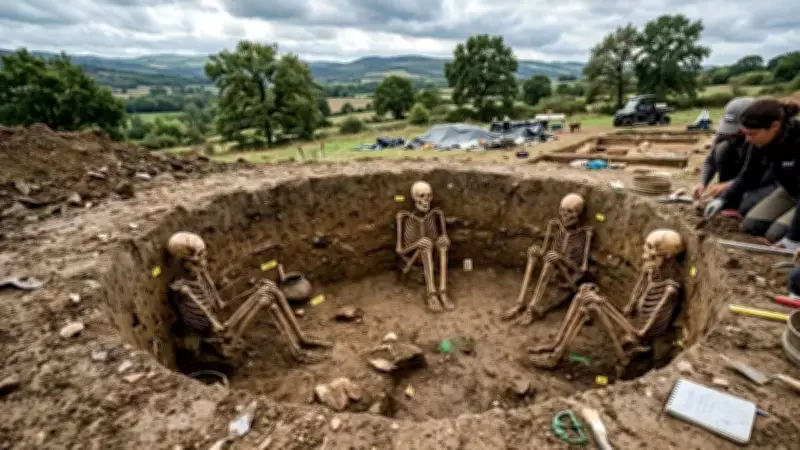
Ancient Celtic 'Seated' Burials Unearthed in France Challenge Archaeological Norms
The archaeological community has been profoundly impacted by the discovery of Iron Age burial sites in France, where evidence points to a funerary tradition that directly challenges established paradigms about ancient Celtic practices. This remarkable find is forcing researchers to reconsider long-held assumptions about social hierarchy and religious rituals in ancient Gaul.
Vertical Interment: A Break from Tradition
The French National Institute for Preventive Archaeological Research (INRAP) has uncovered several Celtic males interred in a seated or vertical deposition within exceptionally large circular pits. Unlike customary burials from the late Gaulish period, these individuals were deliberately not placed in a recumbent or flat position. This deliberate choice suggests an elaborate, previously undocumented social hierarchy or religious ritual specific to this region of ancient Gaul.
According to INRAP reports, sites in regions like Alsace have revealed these circular pits containing bodies in what archaeologists describe as a 'contracted' or seated position. What makes these 'pit burials' particularly intriguing is their distinct lack of grave goods, which typically accompany burials from this period. This absence may indicate these individuals represented a special subset of society or participated in specific ritual events distinct from conventional family-type burials.

Engineering the Afterlife: Maintaining the Seated Position
Research conducted by various sources, including UNESCO World Heritage documentation and French government archaeology, has revealed fascinating details about how these burials were engineered. The 'seated' position was maintained through deliberate taphonomic engineering involving careful back-filling and re-filling of soil in the pits.
Osteologists studying the skeletal remains have reported a crucial finding: the bones show little to no evidence of trauma or injury before burial. This discovery effectively eliminates theories of human sacrifice while simultaneously supporting the conclusion that there existed a very specific, complex inhumation ritual designed to sustain the verticality of the spinal column post-mortem.
From Grain Storage to Human Resting Place
Scientific analysis hosted on ResearchGate and conducted by the French National Centre for Scientific Research (CNRS) suggests these seated burials often occurred in pits originally used for grain storage. The act of burying individuals in decommissioned storage silos represents a globally anomalous funerary practice.
This functional transformation carries significant symbolic weight. The burial of these men in upright positions within former grain storage facilities may symbolize fertility, protection of goods and resources, or perhaps ritualized marginalization. Alternatively, it could represent symbolic guardianship, separating these burials from the main community cemetery while maintaining a protective relationship with vital resources.
A Pan-European Celtic Rite or Localized Practice?
The Oxford Radiocarbon Accelerator Unit has dated these French finds to between 450 and 50 BCE, placing them squarely within the La Tène cultural horizon—a period coinciding with significant Celtic expansion across Europe. This timing raises important questions about the broader cultural context of these burials.
Archaeologists are now making comparisons between these seated burials and other similar yet isolated instances found throughout Europe. The central question researchers seek to answer is whether this represents a broad Celtic practice that spread during their expansion or a localized ritualistic idiosyncrasy exclusive to the tribes of ancient Gaul. The answer could reshape our understanding of Celtic spiritual beliefs and funerary practices during the first millennium BCE.
With continuing osteological studies and radiocarbon dating of these remains, what began as a local archaeological finding is rapidly transforming into a subject of global archaeological inquiry. These seated Celtic graves offer unprecedented insights into the superstitious nature of Celtic funerals and spiritual beliefs, challenging researchers to reconsider established narratives about Iron Age European societies.