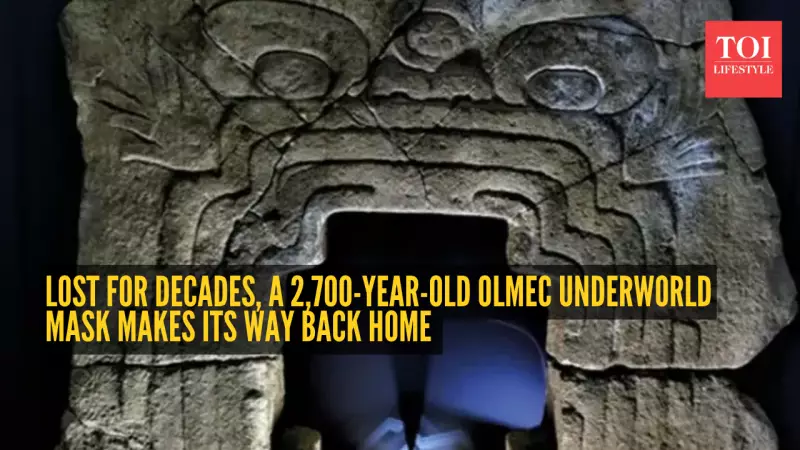
For over a century, the whereabouts of a monumental piece of Mesoamerican history remained a mystery. A colossal stone carving, crafted by the ancient Olmec civilization nearly 2,700 years ago, had vanished from its home in Mexico. Its journey through the shadows of the illicit antiquities trade finally ended this year, marking a triumphant and hard-won homecoming.
The Lost Portal to the Underworld
This priceless artifact is known as the Olmec Cave Mask, or Portal al Inframundo (Passage to the Underworld). Measuring an impressive six feet by five feet, the sculpture is a representation of the Olmec jaguar god, Tepeyollotlicuhti, identifiable by its fierce, flaring eyes and wide-open mouth. It originally stood guard in Chalcatzingo, in Mexico's Morelos state, a site famed for its early Olmec art and monumental rock carvings.
Sometime in the early 1900s—the exact date lost to time—looters brazenly removed the sacred mask from its archaeological context. It then disappeared into a clandestine network, passing through various museums and private collections across the United States for decades. By 2023, the fragmented masterpiece had resurfaced in Denver, Colorado. Its detection triggered a swift response from the Antiquities Trafficking Unit of the New York District Attorney's office, which secured the artifact and paved the way for its repatriation to Mexico.

A Fractured Journey and Painstaking Restoration
New York District Attorney Alvin Bragg highlighted the mask's significance, calling it a "rare window into the past of Olmec society." He also noted a common tragedy of looted art: to ease smuggling, the massive mask had been broken into several pieces. The damage was severe. Experts from Mexico's National Institute of Anthropology and History (INAH) discovered the sculpture was fractured into 25 separate fragments.
To avoid further stress from transport, INAH specialists began a meticulous restoration process in situ. Their goal was to provide the fragile artifact with greater stability and a coherent visual form. The restoration revealed a history of previous, improper repairs. Mario Córdova Tello, an INAH investigator, explained that while some original elements remained, others included a metal structure held by bolts, cement reinforcements, and replacements made with unsuitable techniques and materials. Some of these later additions will remain to preserve the statue's current stability.
The Persistent Hunt and a Bittersweet Victory
The successful return is the culmination of persistent, cross-border detective work by dedicated researchers. The crucial link was first made by archaeologist David Grove, who connected the recovered pieces to the long-missing mask from Chalcatzingo. INAH's investigation later confirmed the theft and traced the artifact to a private collector in Colorado, who had possessed it since at least 2008.
In a poignant twist of fate, David Grove, whose identification work was pivotal, passed away just one day before the sculpture arrived back on Mexican soil. He did not live to witness the final chapter of the recovery he helped initiate.
The return of the Tepeyollotlicuhti portal is a significant but rare victory. It underscores a global problem where countless indigenous artifacts remain scattered in institutions and private holdings worldwide, often with murky provenance. As demands for historical accountability and restitution grow louder, this Olmec masterpiece stands as a powerful testament to what can be achieved when decades of silence are broken by determined action.