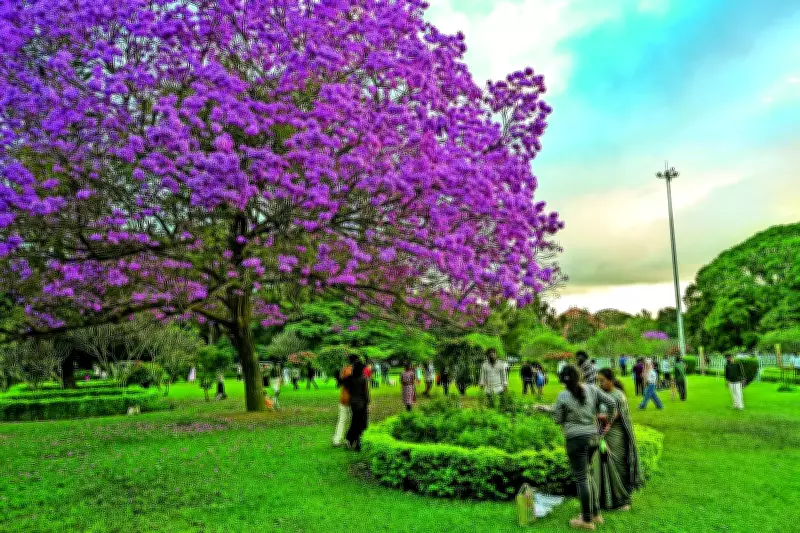
Bengaluru's Walking Renaissance: How Heritage Trails Are Redefining Urban Connection
In the bustling metropolis of Bengaluru, a quiet revolution is unfolding on foot. Curated walks—spanning heritage trails, neighborhood explorations, market and food walks, park rambles, and even midnight bike tours—are fundamentally reshaping how people experience this dynamic city. On World Heritage Day, many are choosing to step away from traffic snarls and brewery hopping to embrace walking as a powerful means to reclaim intimacy, memory, and meaning in urban life.
Everyday Heritage: The Heartbeat of Bengaluru
Priya Chetty Rajagopal, civic evangelist and founder of Heritage Beku, emphasizes that Bengaluru's true heritage extends far beyond its palaces and iconic buildings. "It lives in the everyday. It's the chakota seller outside Cottonpet, the rustle of old rain trees in Cubbon Park, the evening aarti at a 200-year-old temple tucked between glass towers," she explains. Rajagopal argues that celebrating this everyday heritage isn't mere nostalgia—it's an act of resistance and belonging. "It tells our children where they come from. It gives our migrants a way to root themselves. Bengaluru's future is brighter when it remembers its past."
She adds a crucial perspective on the city's identity: "Bengaluru isn't 'new'—it's ancient and reborn many times over. And we must allow its many rebirths to make it stay current and generation relevant."

Walking as Discovery: Beyond the Outer Ring Road
For participants like Dev, a software engineer, these heritage walks have revealed dimensions of Bengaluru previously hidden. "During these heritage walks, I've discovered a side of Bengaluru that goes far beyond the Outer Ring Road and its traffic," he shares.
Raksha Nagraj, founder of Bengaluru Prayana, a storytelling-led platform focused on the city's history and culture, highlights the transformative power of walking's slower pace. "Walking slows people down. It allows them to notice inscriptions, old shop boards, the alignment of streets, and the way community spaces are used. Reading gives you knowledge, but walking gives you context."
From Singapore to Bengaluru: A Tourism Epiphany
The inspiration for walking tours often comes from unexpected places. For Vinay, founder of Gully Tours and a leadership coach, the concept emerged from a question about tourism and storytelling. While working in Singapore in the late 2000s, he was struck by how a city-country half the size of Bengaluru attracted more tourists than all of India. "Singapore has a 50-year-old history. We have 5,000 years of heritage. That contrast stayed with me," he recalls.
Storytelling Without Lectures: Making History Engaging
For Raksha Nagraj, walking was never merely about movement. "When I travelled, I explored cities by walking slowly—observing buildings, markets and people. That's when I realised how many stories in Bengaluru are hidden in plain sight," she says. What began as personal exploration evolved into dedicated storytelling through blogs and videos, eventually leading to heritage trails as the most natural medium. "People connect deeply with neighbourhood walks and market walks because they see everyday life unfolding," she observes.
Vinay experienced a similar revelation during a walking tour abroad. "I realised how powerful walking can be. You pause, you look around, you absorb more. Research even shows that the human brain absorbs information better when you're walking at that pace." However, he emphasizes a critical principle: "Nobody wants a history lecture. What matters is keeping it fun, interesting and engaging. Once people understand why something is cool or important, advocacy comes naturally."

Universal Appeal: Three Generations Walking Together
These walking tours attract remarkably diverse audiences. Vinay explains, "Walking tours attract a surprisingly wide audience. We often have three generations of a family walking together—longtime residents, people who've just moved to Bengaluru, and those who are simply curious about the city." Raksha confirms this broad demographic reach: "I've had participants from their 20s to their 80s. Some are locals, some are first-time migrants, some are tourists. Many become repeat walkers. Once they come, they fall in love and keep coming back."
Building Emotional Connection and Belonging
Both curators firmly believe that walking fosters profound emotional connections with the city. Raksha shares, "When people walk with us on MG Road or in Cantonment, they say, 'Oh my God, I've never noticed this before.' That's when they realise how history and daily life overlap."
Vinay articulates the core philosophy: "You don't really understand a city unless you walk it. Walking creates connection. It makes people care." For Raksha, cultivating this sense of care is the ultimate objective. "We want people to start loving the city and feeling that they belong here. Bengaluru has so much history, culture and everyday beauty—and it doesn't all lie on the outskirts. It's right here, on our streets."
Popular Heritage Walk Trails in Bengaluru
- KR Market
- Malleswaram
- Gavipuram
- Cantonment
- MG Road
- Cubbon Park
- Avenue Road
Through these immersive experiences, Bengaluru's heritage walks are not just tours—they are pathways to deeper urban understanding, community building, and cultural preservation in one of India's most rapidly evolving cities.