From Croissant to Prashant: How Mispronunciations Make Foreign Foods Our Own
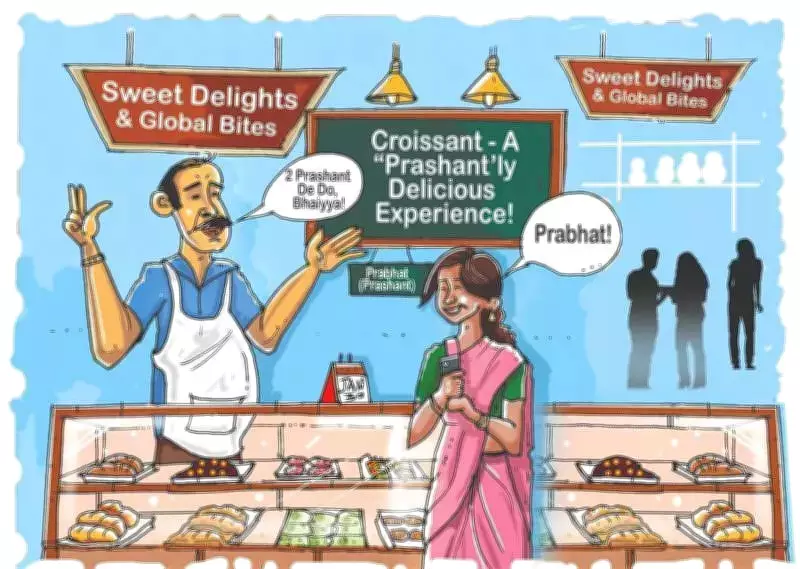
In Pune, a simple video of a young boy confidently misnaming a croissant as "prashant" ignited a social media firestorm, transcending mere meme status to become a cultural moment. Britannia, seizing the opportunity, playfully rebranded its own croissants as "rashant," showcasing how such linguistic twists can capture the nation's imagination.
The Norm of Mispronunciation in India
Across India, mispronouncing foreign food names is not an exception but a widespread norm. "Crêpe" (krehp) often becomes "crape," "crème brûlée" (krem broo-lay) morphs into "cream broo-lee," and "schnitzel" (shnitsel) is humorously rendered as "snitch-sale." In this multilingual, masala-loving country, getting it "wrong" is frequently our unique way of making foreign cuisines feel more accessible and our own.
Personal Anecdotes and Linguistic Jugaad
Navdeep Tupe, an IT professional from Pune, shared a memorable experience at a Mexican restaurant. "I knew what a quesadilla was from TV shows and movies and wanted to try it," he recalled. "Struggling to order, I said 'kwesadilla.' The owner, with a clever linguistic jugaad, told me to pronounce it as 'kaise diya,' like asking a vendor for a price. It made ordering effortless and fun."

Teaching German and the Humor in Mispronunciation
Tanmay Tagare, a German teacher at the Goethe-Institut/Max Mueller Bhavan in Pune, noted that pronunciation is half the battle and often half the fun. "Teaching German in India involves watching students confidently, and hilariously, mispronounce foreign food names," he said. "For instance, Sachertorte (zakh-er-tor-teh), a Viennese chocolate cake, is linked by students to 'sakhar,' meaning sugar in Marathi."
Tagare added more examples: "Muskatnuss (moos-kaat-nooss) means nutmeg, but 'Muskat' sounds like 'muskatt,' a slap in local slang. 'Wange' (vahn-geh) means cheek, but students laugh because it resembles 'vaange,' brinjal. And 'Dickmilch' (dik-milkh), a sour milk, elicits awkward reactions when said in English."
Mispronunciations Beyond International Cuisine
Not just foreign dishes, but Indian regional foods also face creative mispronunciations. "Nenjelumbu rasam" turns into "ninja rasam," and "Chemmeen Ularthiyadhu" becomes a guessing game for many.
Adeline Lannes, a French intern in Kolkata, found the croissant-prashant trend hilarious. "My friends in France made reels asking for 'prashant' at cafes," she said. "It shows Indians' love for croissants, both at home and abroad. We French also stumble with Indian food—I once called 'sandesh' a 'sandwich' until corrected politely."
Hospitality Insights and Regional Nuances
Preetam Shah, a hospitality executive from Surat, observed mispronunciations among foreigners and non-locals. "During my hotel management in 2018, a foreign student kept calling 'kadhi' 'curry,'" he recalled. "I explained that kadhi uses yogurt and gram flour, distinct from curry. Non-Gujaratis often say 'Aka Dad' for 'Akha Adad,' highlighting people's eagerness to try new foods, pronunciation aside."
Evolution of Regional Pronunciations
Shruti Mahajan, a home chef from Bengaluru, is fascinated by how regional pronunciations evolve and spark friendly debates. "At a food festival, there was a panel on whether it's 'do-sa' or 'do-sha,'" she said. "As a Tamilian, I clarified that 'dosai' is the original term. Such discussions show our dynamic food culture."
This phenomenon underscores how mispronunciations are not mere errors but reflections of cultural integration, humor, and the universal desire to explore new culinary horizons, making every dish a little more our own.