As December rolls around each year, audiences worldwide return to a familiar festive ritual: revisiting Charles Dickens' timeless novella, A Christmas Carol. First published in 1843, the story of the miserly Ebenezer Scrooge has transcended its origins to become seasonal folklore. Yet, nearly two centuries later, its haunting questions about wealth, poverty, and human obligation refuse to be silenced, offering one of literature's most enduring critiques of economic philosophy and social morality.
The Ghosts of Economics Past and Present
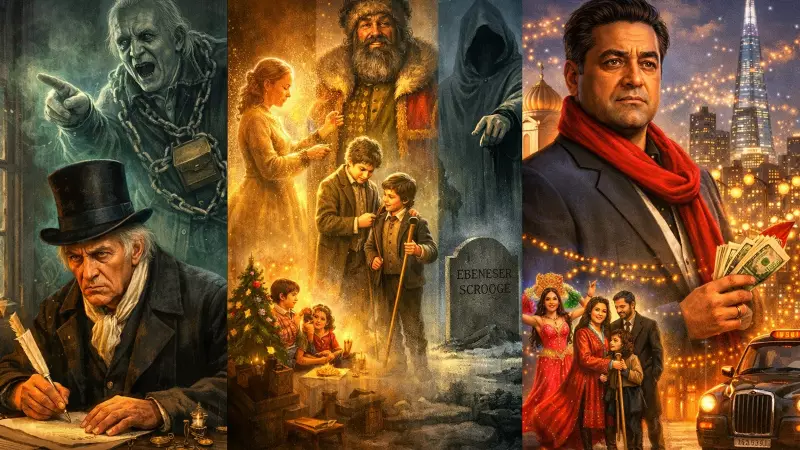
Dickens penned his iconic ghost story during Britain's "Hungry Forties," a decade marked by stark industrial expansion, mass urban poverty, and a prevailing utilitarian ethos. The plot is deceptively simple: on Christmas Eve, the wealthy London moneylender Ebenezer Scrooge is visited by the ghost of his former partner, Jacob Marley, and three spirits—Christmas Past, Present, and Future. They force him to confront his isolated childhood, the present consequences of his stinginess, and a lonely, unlamented future.
Scrooge’s worldview, where poverty is a personal failing and charity is folly, was shaped by the political economy of his time. Institutions like the Poor Law Amendment Act of 1834 had established harsh workhouses, and thinkers provided moral cover, arguing that suffering taught discipline and charity distorted markets. Scrooge’s infamous retort to charity collectors—"Are there no prisons? Are there no workhouses?"—and his reference to the "surplus population" echo the cold, Malthusian logic of the era, not mere personal cruelty.

A Conversion That Questions Human Nature
The story culminates in Scrooge’s dramatic conversion. Waking on Christmas morning, he abandons his lifelong beliefs, raises his clerk Bob Cratchit’s salary, and becomes a benefactor to Cratchit’s ailing son, Tiny Tim. This rapid transformation has long been debated. Literary critic Edmund Wilson, in his essay The Two Scrooges, dismissed it as psychologically implausible, predicting Scrooge would relapse into miserliness.
However, scholar Elliot L. Gilbert offered a different reading in The Ceremony of Innocence. He argues Dickens was not aiming for realism but conducting a "metaphysical study" of a man rediscovering his innate innocence. Scrooge’s miserliness, in this view, stems from a tragic belief that security and wholeness can be rebuilt through material accumulation—a chain forged "link by link," much like Marley’s spectral burden. The ghosts expose the failure of a system that measures human worth solely by productivity and economic output.
Children as the Measure of a Society's Health
Dickens consistently placed moral truth in the treatment of society’s most vulnerable: children. In the tale, the frail Tiny Tim is a direct measure of social failure; his threatened death results from neglect and poverty. A pivotal moment comes when the Ghost of Christmas Present reveals two wretched children named Ignorance and Want, warning Scrooge to "beware them both."
This was a direct challenge to Victorian readers in an age of child labour. For contemporary audiences, it resonates against modern manifestations like child poverty, educational inequality, and systemic neglect. Dickens’s core argument remains potent: these conditions are not inevitable but the result of human choice and policy.
A Carol for the 21st Century: Adaptations and Enduring Legacy
The story’s adaptability secures its relevance. In 2025, director Gurinder Chadha released Christmas Karma, a musical reimagining that transplants the narrative to contemporary multicultural London. Here, Scrooge becomes Mr. Sood, a wealthy British-Indian businessman, with the score blending Bollywood, gospel, bhangra, and pop. While critical reception was mixed, the adaptation proved the novella’s framework remains a powerful lens for examining modern issues of inequality, diaspora, and belonging.

The legacy is also lexical. Thanks to Dickens, the name Scrooge—likely derived from verbs meaning to squeeze or scrounge—entered the language as a synonym for a miser. The Oxford Learner’s Dictionary defines it as "a person who is very unwilling to spend money."
Ultimately, A Christmas Carol endures because it defiantly rejects the idea that human worth must be earned. Its ghosts return each December because the economic and moral conditions they confront—the clash between cold economic logic and warm human obligation—persist. Dickens’s festive tale refuses to settle into mere comfort because its central, haunting question remains unanswered for every generation: what do we owe to one another, simply because we are human?