

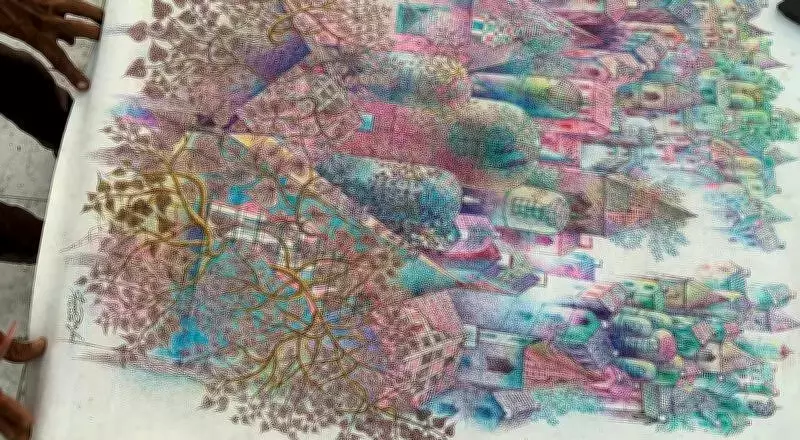
From Parisian Acclaim to Terrace Solitude: The Forgotten Genius of Ahmedabad's Textile Artist
In the bustling heart of Ahmedabad, a city once defined by its booming textile mills, the story of Sharad Rasiklal Jani stands as a poignant testament to artistic brilliance and its fragile legacy. Now 85 years old, Jani lives in near-total anonymity on the terrace of a Gheekanta building, a stark contrast to the acclaim he once commanded as a master textile designer whose work captivated international audiences.
A Flourishing Career Rooted in Ahmedabad's Textile Heritage
Sharad Jani's journey began in the vibrant era of Ahmedabad's textile industry. He launched his career at the prestigious Rajnagar Mill before transitioning to Ambika Mills, where his exceptional talent earned him a starting salary of Rs 150 in 1962, with annual increments of Rs 10—a substantial sum that reflected his growing reputation. Even as a young artist, Jani was celebrated for his innovative "growing flowers" compositions and intricate saree pallav patterns, which set him apart from contemporaries who often relied on static, repetitive motifs.
His designs were not merely decorative; they told a story of movement and life, with flowers that appeared to bloom and flow dynamically along the length of a saree. This artistic vision kept his creations in print for years, cementing his status as a sought-after designer. Jani honed his craft under the guidance of mentors like Chandrakant Bhavsar and the legendary Rasiklal Parikh, absorbing techniques that would later define his career.

International Recognition and a Parisian Sojourn
Jani's ambitions soon transcended local mills. After a stint with the Textile Corporation of Marathwada in Mumbai, an opportunity arose that would change his life. "The French Embassy was right across the street from my office," he recalls. "I got a visa and left for Paris." From 1984 to 1989, Jani immersed himself in the French capital's artistic scene, taking on various jobs while selling his own works.
His breakthrough came when he noticed a sign for SLO, a French company seeking a textile artist. Impressed by his portfolio, SLO hired him for a six-month project where Jani created intricate designs for embossed jackets, showcasing his versatility and skill to an international audience. This period marked the peak of his professional life, with his work earning admiration from Parisians and solidifying his identity as a master artist.
A Return to Ahmedabad and the Descent into Obscurity
Upon returning to Ahmedabad, Jani continued to innovate, writing a column for a Gujarati newspaper on patchwork, design, embroidery, and fashion. He also ventured into engraving, mastering techniques on glass, granite, and brass—a rare expertise in Gujarat that brought him commissions from esteemed clients, including the Sabarmati Ashram authorities.
However, over time, commissions dwindled, and a devastating fire ravaged his once-bustling studio, leaving behind only charred remnants of his meticulous engravings and paintings. Today, Jani's world is confined to a terrace he has called home for nearly three decades, where an old iron bed and a makeshift tent offer scant protection from the elements. His belongings are scattered across the concrete, and his trusted companions are two stray dogs, the last of a pack he once cared for.
Life on the Terrace: Stray Dogs as Family and a Meager Existence
"These animals are my only family now," Jani says, his voice fragile yet resolute. "I can't leave them behind to go anywhere else. Their trust is my only real earning." He spends Rs 100 daily on meals for his pets—milk, rotis, and fruits—while subsisting on a modest diet of bananas and moriya (barnyard millet) for himself. Jani survives on the meager monthly interest from his small savings, having chosen not to live with his wife or two daughters in the city's affluent outskirts.

Local police teams regularly check on the frail artist, and neighbors like Trikam Purohit, a trader who has known Jani since 1998, express deep concern. "It's painful to see a man of his stature spend every rupee feeding the strays while he eats once a day," Purohit remarks. "He is a magnificent artist and mentor." Jani's hands, once celebrated for their magic in Paris, now take on small works to get by, a far cry from the grandeur of his past.
A Legacy Fading into the Shadows
Sharad Jani's story is a powerful narrative of artistic dedication, international success, and the harsh realities of aging and neglect. His engravings on the terrace walls serve as a silent canvas of his life's work, while the fire-ravaged studio below stands as a ghost of his professional achievements. As he reflects on his journey, Jani notes, "Earlier, my work was my identity. Today, it's these dogs." His tale underscores the fleeting nature of fame and the enduring bond between humans and animals, leaving a lasting impression on those who witness his resilience in the face of obscurity.





