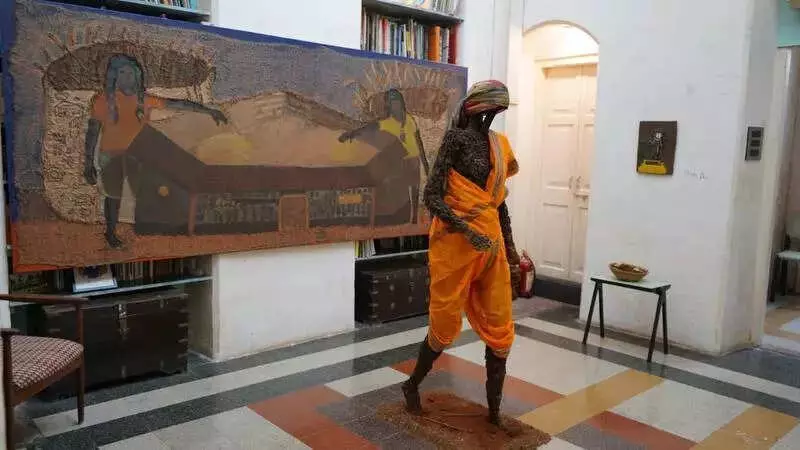
In a striking juxtaposition within South Mumbai, a gallery now hosts a powerful deity from the forests of central India. Just 300 meters from the Colaba police station's shrine to Khada Devi, the goddess of the creeks, stands Mankoo Devi—a nature deity from the Gond pantheon. Clad in a yellow kasta sari with a shrouded face and bamboo limbs caught mid-stride, this figure represents a restless spirit said to possess one person annually. This installation is the centerpiece of Prajwal Naitam's first solo exhibition, 'Purkhaalk / Ancestors: Under the Canopy of Faith', on view at Strangers House until January 3.
Reconnecting with Gond Heritage Through Art
The exhibition is a deeply personal journey for 24-year-old Prajwal Naitam, a recent graduate of Sir JJ School of Art. Growing up in Chandrapur, where her policeman father was posted, she felt cut off from the language, music, and folk songs of her ancestral village near Wardha. To reconnect, she embarked on family interviews and travels across Gadchiroli and Chandrapur districts. Chandrapur, like Nagpur, was founded by the Chandas, a Gond dynasty, and is now a region known for its large tiger population and extensive coal mines.
Her research immersed her in the world of the Gond community, which has the third-largest population in Maharashtra after Madhya Pradesh and Chhattisgarh. Spread across the Gondwana region, they are united by the Gondi language, shared rituals, and a rich pantheon of forest deities grouped into clusters like Sat-Dev (seven deities) and Nav-Dev (nine deities). Naitam's work seeks to give voice to the often-unseen women in Gond folklore.

Fieldwork, Exclusion, and Electric Rituals
Naitam's path to the exhibition was not without obstacles. Earlier this year, she traveled to Jalanaa to document Bada Dev Gango Puja, a sacred cleansing ritual. She was turned away because she was menstruating, told she must not step into the shadow of the ritual's mahua tree. The refusal stung, but she persisted, heading to Jagjai village in Yavatmal where the same ritual was unfolding on a grander scale.
There, she witnessed the thunder of drums, families preparing offerings by the river, and an atmosphere crackling with belief. "Once you step under the mahua tree's canopy, you cannot look back," she recalls. It was here she fully grasped the essence of Mankoo Devi's restlessness, which she later channeled into a large, faceless bark sculpture. "The spirit is not bound to gender," Naitam explains.
Beyond Dots and Motifs: A Contemporary Gond Voice
Curator Sumesh Sharma highlights that Naitam's show resists the commercial pressures often placed on young Gond artists to reproduce the globally recognized dot-and-motif style popularized by masters like Jangarh Singh Shyam and Bhajju Shyam. "Such patterns tend to relegate the artists to labels like 'indigenous' or 'tribal,' disallowing them a space in the contemporary art scene," Sharma states.
Instead, Naitam's landscapes stretch like impressionist savannahs, evoking the mahua flowers, cave dwellings, and tigers of eastern Maharashtra under the threat of coal mining. The exhibition, installed within a mud-textured, cave-like structure inspired by traditional Gond dwellings, is filled with stories. One poignant tale is 'The Bamboo Girl', where a girl named Sundariya is reborn as a guardian spirit from a bamboo shoot. Naitam observes that women often gasp at this story, while men sometimes chuckle. "The stories are not for everyone," she notes dryly.
Naitam identifies not with organized religion but as an animist. "I believe nature regulates us," she says, a philosophy evident in sculptures like a girl draped in shed snakeskin and figures of animals from forests now degraded by mining. Through 'Purkhaalk', she creates a vital portal, much like the ancient cave paintings she references, calling back the spirits of a culture and an ecosystem in flux.