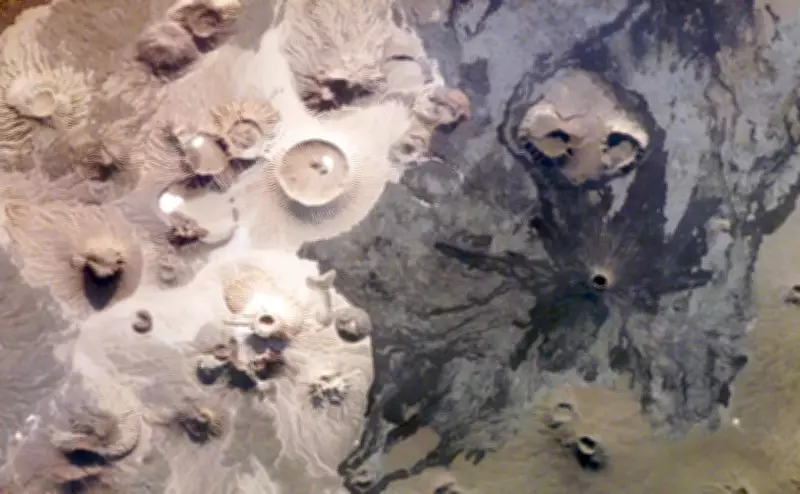
Saudi Arabia's Harrat Khaybar Lava Field Holds Vast Prehistoric Landscape
Across the dark lava plains of Harrat Khaybar in northwestern Saudi Arabia, low stone lines and geometric shapes sit quietly against the rugged basalt terrain. What once appeared to be an empty volcanic expanse is now recognized as a treasure trove of prehistoric architecture, with hundreds of large stone structures identified through advanced satellite imagery and limited field surveys. Archaeologists report a diverse array of enclosures, cairns, desert kites, and long rectangular formations known as gates, spread across approximately 14,000 square kilometers. Many of these structures remain undated, but researchers broadly associate them with Neolithic communities that thrived in the region during wetter climatic phases in the early Holocene.
Unveiling the Prehistoric Features Through Aerial Perspectives
The report highlights a significant concentration of prehistoric stone structures in Harrat Khaybar, one of Arabia's largest lava fields formed by ancient volcanic eruptions. For decades, this area was primarily viewed as a geological site, but modern satellite imagery has revolutionized this perception. Researchers have cataloged hundreds of large stone constructions scattered across the lava landscape, including:
- Circular and rectangular enclosures
- Long stone walls
- Desert kites, which are large funnel-shaped stone structures
- Gates, rectangular stone outlines resembling field gates from an aerial view
- Burial features such as cairns and keyhole tombs
Many of these structures are clearly visible from the air but challenging to recognize at ground level. The arid climate has preserved them exceptionally well, creating what experts describe as a prehistoric landscape frozen in time, offering invaluable insights into ancient human activities.

Understanding Desert Kites and Mysterious Gates
Desert kites are among the better-understood structures in Harrat Khaybar. These consist of large stone walls forming a wide funnel that narrows into an enclosure. Archaeologists believe they were used as animal traps, guiding herds into confined spaces for capture or slaughter. Some researchers speculate they may represent early attempts at animal management or proto-domestication, indicating sophisticated hunting strategies by Neolithic societies.
In contrast, the so-called gates remain more enigmatic. From above, they appear as simple rectangular shapes constructed from low stone walls. They do not obviously resemble houses, pens, or tombs, leaving their purpose unknown. Hypotheses suggest they may have served ritual, territorial, or symbolic functions, but firm evidence is yet to be uncovered, adding to the mystery of this ancient site.
The Role of Satellite Imagery and Dating Efforts
Although some structures were noted decades ago, systematic identification became feasible only with modern satellite imaging. The aerial perspective reveals patterns, including alignments stretching for kilometers, which may indicate ancient travel routes or territorial boundaries. This technology has been crucial in mapping the extensive network of stone features across the vast lava field.
Researchers are actively working to date these structures by analyzing nearby lava flows that intersect some of the stone features. If a lava flow covers or cuts across a structure, it must be older than that eruption. Scientific methods such as argon dating and archaeomagnetic analysis are being employed to establish a clearer timeline. Preliminary findings suggest the region supported organized Neolithic communities during a wetter climatic period, with the scale and variety of structures pointing to coordinated labor and social organization.
In summary, Harrat Khaybar is no longer perceived as an empty desert. It emerges as a major prehistoric landscape, with many of its largest structures still awaiting detailed explanation, promising further discoveries as archaeological investigations continue.