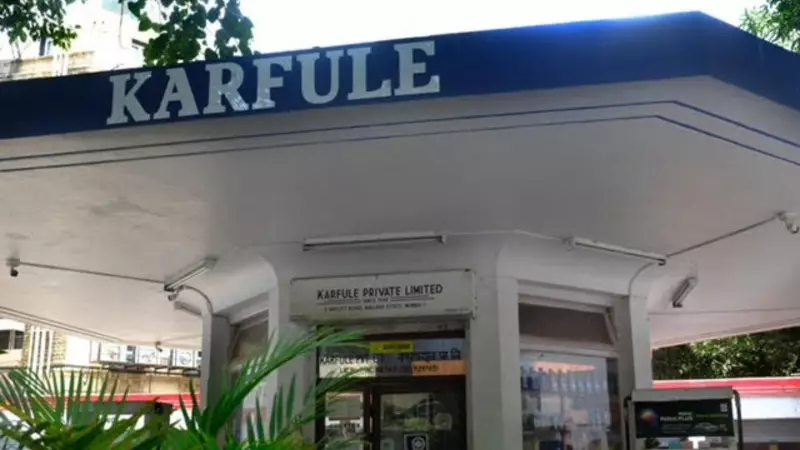
In the quiet, timeless lanes of Ballard Estate in South Mumbai, where Edwardian neoclassical buildings stand as silent sentinels of history, a unique piece of the city's automotive and architectural past continues to operate. This is Karfule, Mumbai's last surviving Art Deco petrol pump, a functional heritage site that has been fueling cars and curiosity since 1938.
A Living Slice of Mumbai's Art Deco Heritage
As Mumbai celebrates the centenary of its iconic Art Deco movement this year, Karfule stands as a rare, working-class monument to that era. More than just a service station, its very name—a clever blend of 'car' and 'fuel'—hints at its modernist origins. The building was constructed in 1938 with concrete and a stone facade designed to harmonize with the surrounding colonial structures of Ballard Estate.
The architectural genius behind this petrol pump was Gajanan B. Mhatre (G B Mhatre), one of Mumbai's most prolific Art Deco architects. Mhatre's legacy includes famed city landmarks like Empress Court at Oval Maidan and residential buildings such as Marble Arch and Shangri-La on Cumballa Hill. At Karfule, his design centered on a distinctive octagonal kiosk crowned with an umbrella-like canopy and a tower featuring an aerodynamic spine. This tower once housed a circular clock, a quintessential Deco detail.

Three Generations of the Sequeira Family Legacy
The story of Karfule is inextricably linked with the Sequeira family, who have run the station for three generations. The journey began with Gabriel Sequeira, a Goan migrant who arrived in Bombay in the 1920s. He started humbly with a kerbside kiosk, manually filling cars with fuel. By 1932, he partnered with Burmah Shell for his first pump in Ballard Estate.
When the American oil company Caltex entered the Indian market, Gabriel saw a new opportunity. As his son, Kevin Sequeira (now 75), recalls, Gabriel was not permitted to operate stations for two competing companies. He sold his stake in the first pump and officially launched Karfule in partnership with Caltex on October 3, 1938, at its permanent home on 3 Sprott Road.
Today, Gabriel's grandson, Daniel Sequeira, helps steer this heritage enterprise into the modern age, ensuring its story is not forgotten.
Preserving Architectural Details Against Time
Stepping into Karfule is like entering a carefully preserved time capsule. The heart of the station remains the central kiosk, which offers a 360-degree view through its seven original windows. Inside, the original star-shaped terrazzo flooring still gleams, showing remarkably little wear after nearly nine decades.
The design is a masterclass in Art Deco streamlining. The lower walls are clad in red marble and black kadappa stone. Exterior grilles are modelled after car headlamps and radiator grilles from the 1930s, and horizontal red bands run along the service bays. One original metal grille from the 1930s survives, though others were stolen during periods of petty theft in the 1970s and 80s.
The family has fought to maintain the pump's character. In 1995, when HP (which later became HPCL) insisted on painting the facade white, Kevin Sequeira resisted. The company stopped their fuel supply, forcing a temporary concession. However, during repainting for the pump's 80th anniversary in 2018, they cleverly used white accented with red and dark blue, creating a facade that nods to classic Art Deco colour palettes.
From Fuel Station to Heritage Hub
The 80th anniversary in 2018 marked a turning point for Karfule's public identity. Daniel Sequeira organized an exhibition on the premises, displaying memorabilia collected over eight decades. The display included treasures like original invoices, a hand-rendered elevation drawing, and a payment certificate showing a total construction cost of Rs 34,000.
One notable receipt from Simplex Concrete Works & Construction Co. was for Rs 5,000. Photographs from the inaugural day were also shown, depicting His Grace Dr Thomas D Roberts, Bishop of Bombay, blessing the station. For the anniversary high tea, Daniel recreated the original 1938 menu of small cakes, cheese straws, and sausage rolls.

The exhibition was so popular it became a permanent fixture. Now, architecture students and heritage enthusiasts frequently visit, and Daniel often guides them through the display. He also conducts heritage walks around Ballard Estate, culminating at Karfule as a living finale to the area's Art Deco narrative.
A Mechanic's Treasure Trove of Vintage Equipment
Beyond its facade, Karfule is a museum of vintage automotive technology. Much of the original machinery from the 1930s is still in working order, lovingly maintained by Kevin and Daniel. This includes two Manley hydraulic lifts, a Devilbiss compressor, and an analog air gauge. These pieces are not for show; they remain part of the station's daily operations, a testament to both their quality and the family's dedication to preservation.
For Mumbaikars and visitors alike, Karfule is more than a place to refuel. It is a rare, operational touchpoint to the city's glamorous Art Deco past, a testament to one family's entrepreneurial spirit, and a reminder that heritage is not always found behind velvet ropes—sometimes, it's right by the petrol nozzle.