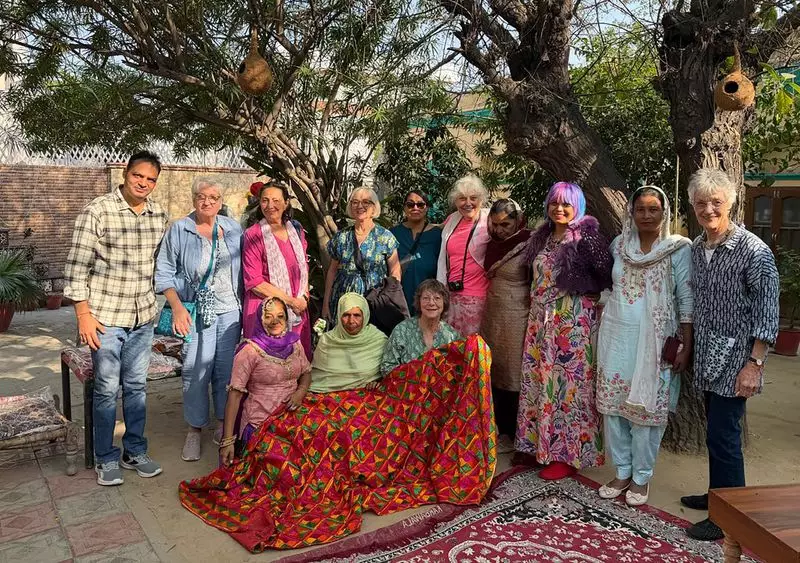
In a significant cultural exchange, delegates from the United Kingdom and Italy recently visited Amritsar to explore the rich tradition of Phulkari embroidery as a powerful form of women's expression. The international delegation engaged with local artisans and experts to understand the cultural significance and artistic nuances of this traditional Punjabi craft.
International Recognition for Traditional Art
The delegation comprised Professor Nicola Brindley from De Montfort University, Leicester, and Dr. Rina Arya from the University of Huddersfield representing the United Kingdom, along with Dr. Lolita Jablonskiene from Italy. Their visit was organized as part of an ongoing research project examining traditional textile arts as mediums of female expression across different cultures.
During their stay in Amritsar, the international scholars visited the historic Khalsa College, where they interacted with faculty members and students from the Department of Fashion Design. The college, known for its commitment to preserving and promoting Punjabi cultural heritage, provided the perfect setting for this cross-cultural dialogue about Phulkari's significance in women's lives and artistic expression.

Phulkari as Women's Narrative Medium
Phulkari, which literally translates to 'flower work,' represents much more than just decorative embroidery in Punjabi culture. The delegates learned how this traditional craft has served as a visual language for women to express their emotions, experiences, and social commentary through intricate needlework.
Professor Nicola Brindley emphasized the importance of understanding Phulkari beyond its aesthetic appeal. She noted that the embroidery patterns and color choices often reflect the personal stories and cultural identity of the women who create them. The floral motifs and geometric patterns characteristic of Phulkari carry deep symbolic meanings that have been passed down through generations of female artisans.
The research team examined how Phulkari has evolved from being primarily created for personal use within families to becoming a recognized art form in the global textile market. This transition has created new economic opportunities for women artisans while raising important questions about cultural appropriation and authentic representation.
Cultural Exchange and Future Collaborations
The visit facilitated a meaningful exchange between international academics and local practitioners of Phulkari embroidery. The delegates had the opportunity to observe live demonstrations of Phulkari techniques and discuss the challenges facing contemporary artisans practicing this traditional craft.
Dr. Rina Arya expressed particular interest in how Phulkari embodies the concept of 'making as thinking' - where the process of creating embroidery becomes a form of meditation and personal expression for women. She highlighted how the rhythmic nature of needlework creates a space for contemplation and emotional processing.
The international delegation's research findings are expected to contribute to academic understanding of traditional textile arts as feminist expressions. Their work may also influence how cultural institutions and museums approach the preservation and interpretation of embroidery traditions from various cultures.
This collaborative initiative between Khalsa College and international universities demonstrates the growing global interest in traditional Indian crafts and their contemporary relevance. The exchange promises to open new avenues for research and cultural partnerships that benefit both academic institutions and local artisan communities.