Historic Christian Shrine in Kochi Successfully Relocated to Preserve Heritage
In a remarkable display of community perseverance and engineering ingenuity, a 200-year-old Christian shrine in Kochi has been successfully relocated to prevent its demolition after Indian Railways acquired the land on which it stood. The shrine, located under St John Nepumsian Church in Konthuruthy, holds profound emotional and heritage significance for local parishioners, who orchestrated an elaborate rescue operation to preserve this piece of their religious history.
The Shrine's Heritage Value and Acquisition Threat
The shrine, measuring 12 feet wide and 14 feet tall, faced imminent demolition when Indian Railways acquired the land in 2023 for railway expansion projects. This was not the first threat to the structure—parishioners recalled that initial attempts to acquire the shrine occurred back in 1983 when the railway track was first laid. At that time, the railways made an exception following parishioner requests, but the 2023 acquisition presented a more serious challenge.
Parishioner Johny Mathew Kalathiveettil, who coordinated the relocation project, shared personal memories of the shrine. "I remember my childhood days when we used to play around the shrine," he said. "After it was acquired by the railways, the parishioners began discussions on the possibility of conserving it. We had heard of lifting buildings, but we did not know it could be shifted over such a distance."

The Complex Relocation Process
The relocation presented significant engineering challenges, as any movement carried a high risk of damaging the historic structure. Parishioners engaged Shri Ram Building Lifting, a specialized agency based in Kurukshetra, Haryana, known for similar projects across India.
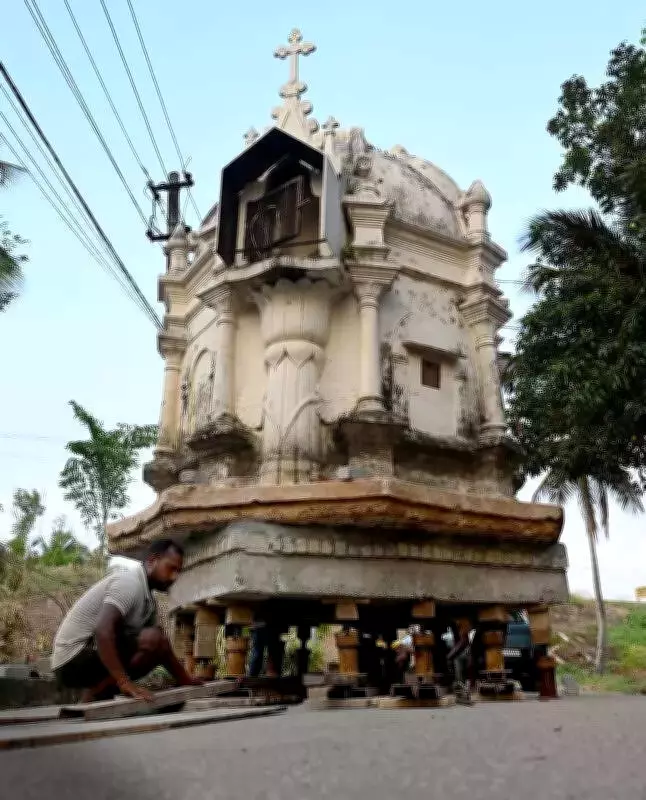
Vikas Rana, managing director of the company, explained the meticulous process that began on March 15. "We use jack systems to manually move the shrine. After separating it from the foundation, jacks were used to lift it to a height of about five feet. Concrete beams were then constructed underneath and the structure was placed on them," Rana detailed.
The engineering team employed an innovative approach using iron rods as temporary "wheels" between the structure's base and temporary rails. Larger jacks were then used to slowly roll the shrine onto an adjacent road, moving it a few feet each day over the course of a week.
Community Effort and Legal Maneuvering
The relocation required careful coordination between multiple stakeholders. By the time parishioners conceived the relocation plan, the railways had already completed the acquisition and paid compensation. When approached, railway authorities informed them that the structure would be put up for auction.
"We entered the auction and bought it back for a nominal sum," Johny revealed. The community then purchased a small neighboring plot—what remained of another property acquired by the railways—located just 25 meters away from the original site. They also secured special permission from the Kochi Municipal Corporation to proceed with the relocation.
Successful Movement and Future Plans
Within a week of careful engineering work, the shrine was successfully moved 18 meters without sustaining any major damage. The parishioners hope to complete the final placement at the new location by Friday, with plans to restore the shrine to its original appearance and beautify the surroundings.
"Once the shifting is complete, we plan to restore its original look and beautify the surroundings," Johny said. "A 14-meter-tall cross will also be placed atop the shrine." The community looks forward to celebrating Easter with the shrine restored to its former glory at its new location, preserving this important piece of Kochi's religious heritage for future generations.
This successful relocation demonstrates how community determination, combined with specialized engineering expertise, can overcome significant challenges to preserve cultural and religious heritage threatened by development projects. The project serves as a model for similar heritage conservation efforts across India facing similar threats from infrastructure expansion.