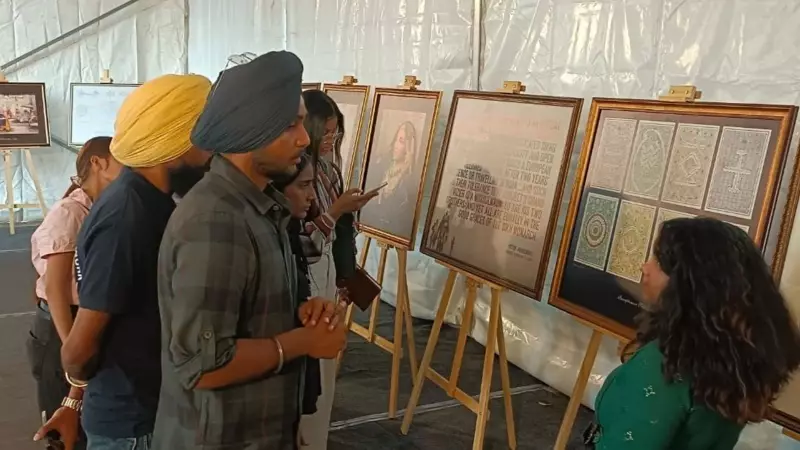
The 9th Military Literature Festival in Chandigarh concluded with a powerful call to re-evaluate Maharaja Ranjit Singh's rule, emphasizing its secular and inclusive nature rather than viewing it through narrow religious definitions. The session urged scholars to recognize the plural character of his administration that transcended religious boundaries.
Questioning Colonial Terminology
Ethnographic researcher Amardeep Singh, renowned for his Lost Heritage documentation project, initiated the discussion by challenging contemporary usage of the term Sikh Empire. He revealed that this terminology largely originated from British colonial writings and failed to capture the diverse nature of Ranjit Singh's governance.
The state historically identified itself as Lahore Darbar or Khalsa Sarkar and maintained remarkable religious diversity within both military and civil institutions. Amardeep emphasized that the administration included significant representation from Sikh, Muslim, Hindu, Dogra, and European communities, reflecting the multicultural fabric of Punjab during that era.

Military Expansion and Frontier Security
Amardeep's presentation detailed the strategic military campaigns that defined Ranjit Singh's rule, particularly focusing on securing Punjab's northwestern frontiers. Beginning in 1809, the Lahore Darbar invested substantial resources in fortifying borders, especially along the crucial Khyber Pass routes that had witnessed repeated invasions.
The legendary General Hari Singh Nalwa emerged as a central figure in these campaigns, leading decisive operations that expanded the Darbar's influence. His significant victories included the capture of Multan in 1818 and Kashmir in 1819, which consolidated control over vital trade and military corridors.
A major achievement came in 1836 with the construction of Jamrud Fort at the entrance of Khyber Pass, effectively curbing Afghan incursions. Beyond military success, Nalwa established Haripur in present-day Khyber Pakhtunkhwa as a well-planned administrative and commercial center, remembered in regional traditions as a protector who brought stability to conflict-affected areas.
Himalayan Campaigns and Cultural Integration
The northern expansion continued under General Zorawar Singh, a Dogra officer serving under Raja Gulab Singh of Jammu. Between 1834 and 1841, Zorawar Singh led challenging campaigns through Ladakh, Baltistan, and western Tibet, demonstrating the Lahore Darbar's extensive reach.
In 1834, his forces navigated the difficult Kishtwar-Zanskar route to capture Ladakh, establishing Leh as a strategic outpost. Subsequent campaigns led to the annexation of Baltistan after sustained engagements with local rulers. The most ambitious operation began in mid-1841 when Zorawar Singh's troops entered Ngari in western Tibet and captured Taklakot (Purang).
While historians debate the motivations behind this expansion, Amardeep suggested it responded to shifting geopolitical dynamics in the Himalayas, including growing British presence. The campaign ended tragically on December 12, 1841, when Tibetan and Qing forces launched a winter counter-offensive, resulting in Zorawar Singh's death near Minsar.
Enduring Legacy Beyond Borders
Amardeep presented fascinating historical accounts revealing how several captured soldiers from these campaigns eventually settled in Tibet, married locally, and integrated into Tibetan society. Their descendants became known as Singpa Khache, tracing lineage to the Dogra-Ladakhi troops of the Lahore Darbar.
This cultural integration exemplifies the plural and secular identity that characterized Ranjit Singh's administration. Concluding his address, Amardeep called for academic and cultural institutions to move beyond sectarian perspectives, emphasizing that the Lahore Darbar was built through shared contributions across religious and ethnic lines.
The session at the Military Literature Festival served as a timely reminder of India's rich heritage of inclusive governance, offering valuable historical perspectives relevant to contemporary discussions about secularism and pluralism in the subcontinent.